
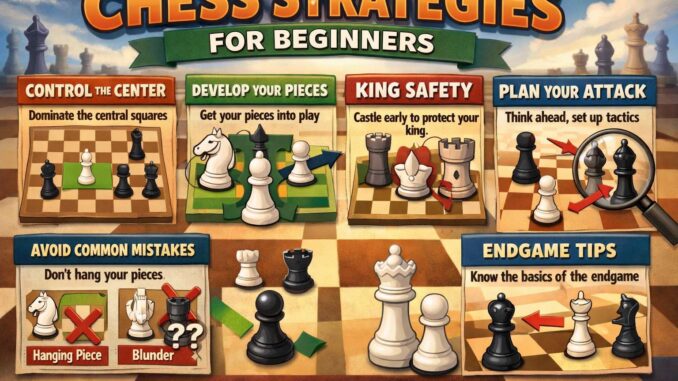
Learning chess can feel overwhelming at first, but with the right approach, anyone can improve quickly. In particular, understanding chess strategies for beginners is the key to playing smarter, avoiding common mistakes, and building confidence on the board. After all, chess is not only a game of pieces—it is a game of planning, patience, and pattern recognition.
Many new players focus only on moving pieces or capturing opponents, but strategy matters much more. Therefore, if you know how to control the center, develop your pieces, and protect your king, you can gain an advantage even against stronger opponents.
In this beginner-friendly guide, we will explain simple and effective chess strategies that help new players win more games and enjoy learning. Similarly, players interested in another abstract strategy game can learn how to play Gomoku.
Why Chess Strategies for Beginners Matter
Chess is not about making random moves. Instead, every move should have a purpose. Specifically, a strong strategy helps you:
- Control important squares
- Keep your king safe
- Coordinate your pieces
- Create attacks
- Defend against threats
- Win material or deliver checkmate
Without a strategy, players often lose pieces or fall into traps early. That is why beginners should develop smart habits from the start.
Control the Center of the Chessboard
One of the most important basic chess strategies for beginners is controlling the central squares: e4, d4, e5, and d5.
Why is the center important?
- First, pieces move more freely from the center.
- Additionally, you gain more attacking options.
- Meanwhile, your opponent’s pieces can become restricted.
- As a result, better board control leads to stronger positions.
Therefore, good opening moves such as 1.e4 or 1.d4 help claim central space immediately.
Develop Your Chess Pieces Early
Development means bringing your pieces into active positions quickly.
A good development order includes:
- First, move pawns to open lines.
- Next, develop knights before bishops.
- Then, castle early.
- Finally, connect the rooks.
However, avoid moving the same piece multiple times during the opening unless necessary.
A common mistake beginners make is pushing too many pawns while leaving pieces stuck on the back rank. Consequently, those undeveloped pieces cannot contribute to attacks or defense.
Castle Your King Early
King safety is essential. Specifically, castling moves your king away from the center while activating a rook at the same time.
There are two types of castling:
- Kingside castling, also called short castling
- Queenside castling, also called long castling
For most new players, kingside castling is simpler and safer. However, if you delay castling, your king can become an easy target in the center.
Don’t Give Away Chess Pieces
Many beginner games are decided by blunders, especially when a player loses a piece for free.
Therefore, before every move, ask:
- Is my piece defended?
- Can my opponent capture it?
- Am I walking into a tactic?
- What is my opponent threatening?
By checking these questions consistently, you can prevent many avoidable losses. Likewise, families interested in other thoughtful tabletop activities can explore the best board games for families.
Learn Strong Chess Openings for Beginners
Opening knowledge helps you start each game with confidence. However, you do not need to memorize dozens of complicated lines. Instead, learn a few reliable systems and understand the ideas behind them.
Some effective chess opening strategies for beginners include:
For White
- Italian Game
- London System
- Queen’s Gambit
- Four Knights Game
For Black
- Scandinavian Defense
- French Defense
- Caro-Kann Defense
- King’s Indian Setup
Ultimately, choose openings that prioritize development, central control, and king safety.
Use Knights and Bishops Actively
Minor pieces are especially powerful during the opening and middlegame.
Knights
- Generally, knights are strong in closed positions.
- Additionally, they are excellent for creating forks.
- Most importantly, they are usually strongest near the center.
Bishops
- Generally, bishops are strong on open diagonals.
- Furthermore, they are useful for long-range attacks.
- Finally, a pair of bishops can become especially powerful.
Therefore, try not to trap your knights or bishops behind your own pawns.
Combine Chess Strategy With Tactics
Strategy provides direction, but tactics can win material quickly.
Important beginner tactics include:
- Forks
- Pins
- Skewers
- Discovered attacks
- Double attacks
- Checkmate patterns
Even the best chess strategies for beginners become stronger when combined with tactical awareness. Therefore, practice puzzles regularly to improve your tactical vision.
Similarly, players who enjoy decisions involving risk and reward can explore Push your luck concepts.
Trade Pieces When You Are Ahead
If you are winning material, simplifying the game is often a strong strategy.
For example:
- If you are ahead by a queen or rook, trade pieces.
- Next, preserve your extra material.
- As a result, you reduce your opponent’s attacking chances.
However, avoid unnecessary pawn trades if they create weaknesses. Overall, this is one of the smartest practical strategies for new players.
Use Rooks on Open Files
Rooks become strongest later in the game.
Therefore, try to place your rooks:
- On open files
- Behind passed pawns
- On the seventh rank when attacking
Many beginners forget about their rooks until it is too late. Consequently, you should activate them once your minor pieces are developed.
Create a Chess Plan
Instead of making random moves, ask yourself:
- Which piece is inactive?
- Where is my opponent weak?
- Can I improve my king’s safety?
- Can I attack a pawn?
- Should I trade pieces?
Even a simple plan leads to better chess. Likewise, solo card-game players can strengthen their planning skills by learning how to win Solitaire.
Avoid Common Beginner Chess Mistakes
Here are several errors many new players make:
Moving the Queen Too Early
Since smaller pieces can attack the queen, it may lose valuable time by repeatedly moving.
Ignoring Opponent Threats
Before every move, ask what your opponent wants to do.
Attacking Too Soon
First, develop your pieces. Then, begin an attack.
Not Protecting Pieces
Because loose pieces are easy targets, keep track of every undefended piece.
Playing Too Fast
Finally, take enough time to evaluate each move.
In many cases, avoiding mistakes is more valuable than finding brilliant moves.
Learn Essential Chess Endgames
Many games eventually reach an endgame. Therefore, beginners should learn these fundamental ideas:
- Activate the king in the endgame.
- Push passed pawns.
- Use opposition in king-and-pawn endings.
- Promote pawns carefully.
- Cut off the enemy king with a rook.
Even strong chess strategies for beginners should include endgame understanding.
How to Improve at Chess Faster
To improve more quickly:
Play Regularly
Whether online or over the board, regular experience helps.
Analyze Your Games
Afterward, identify where mistakes happened.
Solve Puzzles Daily
Even ten minutes of daily practice can help.
Study One Opening at a Time
However, do not overload yourself with too many variations.
Watch Strong Players
As a result, you can learn recurring patterns naturally.
Furthermore, word-game players can improve pattern recognition by studying 2 letter Scrabble words.
Sample Beginner Chess Strategy
Here is a simple opening plan:
- First, play e4.
- Next, develop the knight to f3.
- Then, develop the bishop to c4.
- Afterward, castle kingside.
- Next, bring a rook toward the center.
- Finally, attack weak points.
Overall, this type of structured play gives beginners a solid foundation.
Mental Tips for Beginning Chess Players
Chess improvement takes time. Therefore, remember:
- Losing is part of learning.
- Every mistake teaches you something.
- Focus on progress rather than rating.
- Stay calm under pressure.
- Most importantly, enjoy the game.
Ultimately, patience often defeats frustration.
Final Thoughts on Chess Strategies for Beginners
In conclusion, learning chess strategies for beginners is one of the fastest ways to become a stronger player. Therefore, focus on controlling the center, developing your pieces, castling early, protecting your army, and spotting tactics. Ultimately, these fundamentals can win many games at the beginner level.