
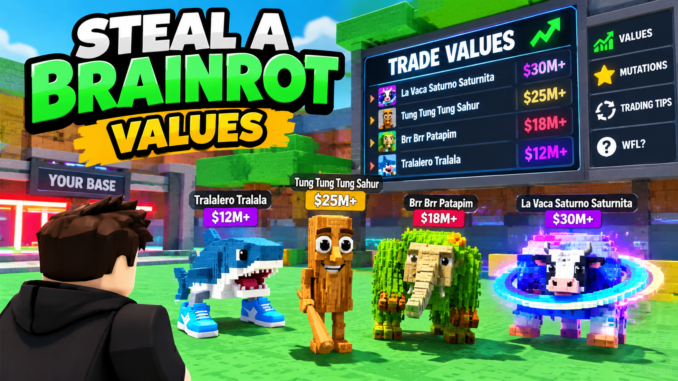
If you are searching for steal a brainrot values, you probably want to know what your Brainrots are worth before making a trade. In Steal a Brainrot, value is not determined by income alone. Rarity, mutations, traits, demand, availability, and current trading activity can all affect what another player is willing to offer.
The market also changes quickly. Community value trackers in September 2026 show noticeable movement among high-demand OG and Secret Brainrots, with some items rising while others fall. Because these are community estimates rather than official developer prices, treat any value list as a trading reference rather than a guaranteed price.
This guide explains how to read Steal a Brainrot values, judge trades, understand mutations, and avoid common trading mistakes.
How Steal a Brainrot Values Work
A Brainrot’s trade value is basically the amount other players are willing to give for it. That sounds simple, but several factors influence the number.
First, rarity matters. OG and Secret Brainrots tend to dominate serious trading because they are harder to obtain and usually have stronger demand. Lower-rarity Brainrots can still be useful for gameplay, but they often have much less trading power.
Next comes income. A Brainrot that produces a large amount of cash per second can attract more buyers because it offers both collection value and practical gameplay value.
However, income does not tell the whole story. Limited supply can make a Brainrot expensive even when another unit produces more money.
Demand is another major factor. If traders are actively looking for a particular Brainrot, its value can stay strong even when another item has similar income.
Trade Value vs. Income
These two numbers are easy to confuse.
Income tells you how much the Brainrot produces for your base.
Trade value tells you what the trading community considers the Brainrot worth.
A Brainrot can therefore have excellent income but weak demand. Likewise, a rare collectible can have strong trade value even if its income is not the highest.
That difference is one of the first things beginners should understand before entering a busy trading server.
Steal a Brainrot Values List: What to Watch
There is no single official value number published by the game that permanently determines what every Brainrot is worth. Community trackers instead estimate values using trading activity, demand, rarity, income, mutations, and other market signals.
For that reason, values can differ between websites.
For example, September 2026 community lists disagree on the exact numbers assigned to several top Brainrots. One tracker places Strawberry Elephant near the top of its community value ranking, while another uses a very different numerical scale.
The practical lesson is simple: compare items using the same value system.
Do not take a number from one calculator and compare it directly with a number from another site.
Quick Value Reference
| Factor | Effect on Trading Value |
|---|---|
| OG rarity | Usually creates very high collector demand |
| Secret rarity | Often forms the core of active high-level trading |
| High income | Can increase demand and usefulness |
| Rare mutation | Can significantly increase an item’s worth |
| Popular traits | May increase value and trading interest |
| High demand | Can push an item above similar Brainrots |
| Limited availability | Can support long-term collector value |
| Falling demand | Can make a previously expensive item harder to trade |
This is why a simple alphabetical list is less useful than understanding what moves the market.
Steal a Brainrot Trading Values and WFL Checks
Before accepting a trade, compare both sides rather than judging the first Brainrot you notice.
A WFL check means Win, Fair, or Loss. Community calculators let players enter the Brainrots on each side and compare estimated values. Current calculators also account for mutations and traits in their calculations.
Still, a WFL result should not replace your own judgment.
Suppose a trade looks technically fair, but you are giving away an item with extremely high demand. You might struggle to replace it later.
On the other hand, you could accept a slightly lower-value bundle if the items are much easier to trade individually.
A Simple Trade Checklist
Before clicking accept, check:
- Base rarity: Is it OG, Secret, Brainrot God, Mythic, or another tier?
- Mutation: Does the mutation significantly increase its value?
- Traits: Are valuable traits included?
- Demand: Are players actually looking for the item?
- Availability: Is it easy to obtain right now?
- Recent trend: Has the value been rising or falling?
- Your goal: Are you collecting, upgrading, or improving income?
- Liquidity: Could you trade the item again if necessary?
This approach is safer than chasing the biggest number.
Steal a Brainrot Values With Mutations
Mutations can dramatically change the value of a Brainrot.
A mutated version is not always valued as simply “the original Brainrot plus a small bonus.” Depending on the mutation and current market, the variant can become a much more desirable trading asset.
Community value systems track mutations such as Gold, Diamond, Rainbow, Bloodrot, Divine, Galaxy, Cyber, and other variants. Some trackers also calculate trait bonuses separately.
That means you should always identify the exact variant before comparing two Brainrots.
Why Mutations Matter
Imagine two players both own the same base Brainrot.
Player A has the normal version.
Player B has a rare mutated version with useful traits.
Even though the base Brainrot is identical, the two items can have very different trade values.
Mutation value can also interact with income. Current community calculators use formulas that combine the base income with mutation and trait effects.
Therefore, never trade a high-end mutated Brainrot based only on the value of its normal version.
Understanding Demand Before You Trade
Demand is one of the most useful concepts for experienced traders.
An item with high demand is generally easier to move because more players want it. A lower-demand Brainrot might technically have a similar value, but finding the right buyer can take much longer.
Current September 2026 trackers show this difference clearly. Some Brainrots listed near the top have high or very high demand, while others with substantial estimated value are marked low or very low demand.
That distinction matters when building a trading inventory.
High Value Does Not Always Mean Easy Trade
A common mistake is assuming that the most expensive-looking item is automatically the best trading asset.
Instead, think about liquidity.
A liquid item has enough demand that you can usually find interested traders without waiting forever.
An expensive but unpopular Brainrot may require you to overpay for the next item just to move it.
So, when two offers are close, demand can be a useful tie-breaker.
How to Read a Steal a Brainrot Values List
When you open a value list, start with the item’s identity.
Check its:
- Brainrot name
- Rarity
- Base income
- Mutation
- Traits
- Estimated value
- Demand
- Recent trend
After that, compare it with the Brainrot you are receiving.
Do not stop after checking the first number.
A current community list can change daily, and some trackers explicitly display previous values and percentage movement.
Watch the Trend
A rising item may attract traders because demand is increasing.
A falling item can be harder to trade if players expect its value to continue dropping.
However, short-term movement does not guarantee what will happen next.
An update, new event, mutation change, or supply increase can quickly change the market.
Best Trading Strategy for Beginners
New traders should avoid trying to turn every trade into a huge profit.
Instead, focus on learning how the market works.
Start by recording the Brainrots you own and checking their current community values. Then watch several trades before accepting offers.
If you see the same Brainrot being offered repeatedly, pay attention to what traders are actually asking for it.
You will gradually learn the difference between a listed value and a realistic player-to-player offer.
Another useful approach is to avoid trading your entire inventory at once. Keep some desirable items available so you have flexibility when a good opportunity appears.
For players coming from other Roblox trading games, concepts such as demand and value lists may feel familiar. For example, guides covering grow a garden trade values can help illustrate the broader idea that community-driven game economies often rely on demand rather than a fixed shop price.
Advanced Trading Tips
Experienced traders can go beyond simple value comparisons.
Look for Demand Gaps
Sometimes two Brainrots have similar estimated values, but one has much stronger demand.
That difference can create opportunities.
A player may prefer the high-demand item even if the numerical values are close. In that situation, the more liquid Brainrot can be easier to trade later.
Separate Collecting From Profit
Before every trade, decide what you are trying to accomplish.
If you want trading profit, liquidity and market movement may matter more.
If you simply want a specific Brainrot, paying a little extra might be reasonable because your goal is ownership rather than resale.
Avoid Panic Trading
Values can move quickly after updates.
When a Brainrot suddenly falls, some players rush to sell. That can create poor trades based on fear rather than actual demand.
Instead, check several current references and look at recent movement before making a major decision.
Community value sites themselves warn that their numbers are estimates and not guaranteed trade outcomes.
Current Market Notes for September 2026
The September 2026 market shows why players should treat value lists as living references.
Recent community trackers report movement among top Brainrots, including Strawberry Elephant, Headless Horseman, Signore Carapace, Dragon Gingerini, and others. Some have recently risen while others have moved lower.
One current tracker lists Strawberry Elephant among the highest-value items, while other community lists produce different numerical scales and rankings.
That variation is normal for a player-driven economy.
Rather than memorizing one number, learn the factors behind the number.
If a new update introduces rare Brainrots, changes mutation availability, or increases the supply of a popular item, old trade expectations can become outdated quickly.
Common Trading Mistakes to Avoid
Trading Without Checking Mutations
A mutated Brainrot should never be valued like its default version.
Always inspect the exact variant before accepting.
Ignoring Traits
Traits can affect both income and community value. Current calculators include trait-related adjustments when estimating Brainrot value.
Comparing Different Value Scales
If one site uses one numerical system and another uses a completely different system, the numbers cannot be compared directly.
Choose one consistent reference when checking a trade.
Trusting “Guaranteed” Profit
No community calculator can guarantee that another player will accept a particular offer.
Market value is an estimate, not a promise.
Trading Under Pressure
Scammers and aggressive traders may try to rush you.
Take a moment to inspect every item, mutation, and trait before confirming the trade.
A Practical Value-Checking Routine
Identify both Brainrots.
Check rarity and base income.
Inspect every mutation.
Check traits and special variants.
Compare community values using the same reference.
Check demand and recent movement.Step 7: Decide whether the items fit your personal goal.
Confirm that the final trade window contains exactly what you agreed to receive.
This takes only a little extra time, yet it can prevent expensive mistakes.
Final Tips for Using Steal a Brainrot Values
The best way to use steal a brainrot values is as a decision-making tool rather than an absolute price tag.
Start with rarity, then check income, mutations, traits, demand, and current market movement. After that, consider whether the Brainrot is easy to trade and whether it actually fits your collection or gameplay goal.
If you are trying to identify strong targets rather than calculate a specific trade, a guide to what is the best brainrot in steal a brainrot can help you compare desirable units from a gameplay perspective.
Most of all, keep checking values after major game updates. The Steal a Brainrot economy can change quickly, so yesterday’s trade price may not be today’s realistic offer.
A smart trader does not simply memorize a list. They understand why an item has value, watch demand, verify mutations, and think about what they can do with the Brainrot after the trade.