
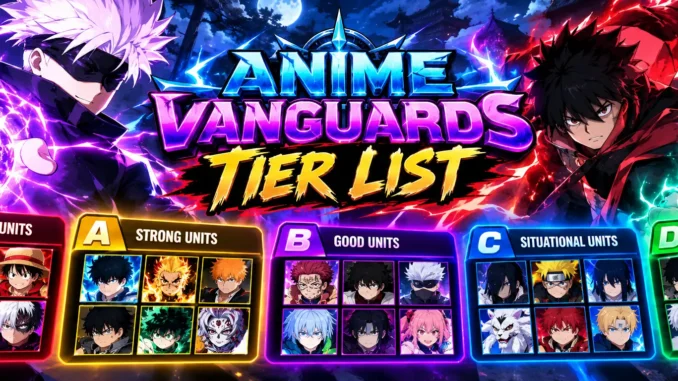
Building a strong team becomes much easier when you understand which units provide the most value, and this Anime Vanguards tier list is designed to help with exactly that. Rather than judging units only by raw damage, a useful ranking also considers range, attack speed, area coverage, utility, upgrades, traits, evolution potential, and performance in difficult content. Since Anime Vanguards changes through updates, balance adjustments, and new unit releases, players should always compare any tier list with the current version of the game.
Anime Vanguards Tier List Explained
Anime Vanguards is not a game where the unit with the biggest damage number automatically becomes the best choice. Instead, team strength comes from combining damage dealers, support units, crowd control, buffs, and other useful effects.
For that reason, this tier list uses broad performance categories rather than pretending every unit has one fixed position forever.
| Tier | General Performance | Best Use |
|---|---|---|
| S | Exceptional | Difficult stages, progression, endgame teams |
| A | Very strong | Most modes and team compositions |
| B | Solid | Progression and specialized roles |
| C | Situational | Early game or specific strategies |
| D | Limited | Temporary use or niche situations |
An S-tier unit usually performs extremely well in several areas. Meanwhile, an A-tier character may be excellent but require better support, upgrades, or positioning.
B-tier units remain perfectly usable. In fact, they can outperform supposedly stronger characters when a stage favors their mechanics.
Therefore, treat rankings as a team-building guide rather than an absolute rule.
What Makes a Unit S Tier?
The strongest units generally combine several advantages instead of relying on one impressive stat.
Damage is obviously valuable. However, damage per second, attack type, placement cost, range, upgrade scaling, and special effects can matter just as much.
For example, a unit with massive damage but extremely slow attacks may struggle against large groups. Meanwhile, another unit with lower individual hits could clear waves more reliably because it attacks quickly and covers a large area.
S-tier candidates usually offer some combination of:
- High sustained or burst damage
- Strong AoE coverage
- Useful range
- Efficient upgrade scaling
- Powerful passive abilities
- Crowd-control or support utility
- Good performance against bosses
- Strong synergy with other units
Availability matters too. A powerful character that requires significant investment may not immediately outperform an easier unit on a beginner account.
If you are deciding whether a difficult-to-obtain unit is worth your resources, an anime vanguards value list can provide another useful perspective alongside combat rankings.
Anime Vanguards Unit Tier List: How to Build Around Rankings
A good Anime Vanguards unit tier list should help you build teams, not simply tell you which characters are popular.
First, identify what your current lineup lacks.
If waves overwhelm your defenses, adding another single-target boss killer probably will not solve the problem. Instead, you may need better AoE coverage, faster attacks, or crowd control.
Likewise, if normal enemies are easy but bosses survive too long, your team may need stronger sustained single-target damage.
S Tier: Core Team Candidates
S-tier units are generally the characters you can comfortably build a team around.
They tend to scale well, perform consistently, and remain useful in demanding content. Some may specialize in damage, while others earn their position through exceptional support or control.
However, do not automatically fill every available slot with high-tier damage dealers. A balanced lineup can perform better than a collection of individually powerful units.
A Tier: Excellent Alternatives
A-tier units sit just below the most dominant options, yet they can still carry teams through a large amount of content.
Many have one minor limitation. For instance, they might require more investment, have slightly weaker coverage, or depend on a particular setup.
Nevertheless, an upgraded A-tier unit that fits your strategy can easily be more useful than an undeveloped S-tier character.
B Tier: Reliable and Often Underrated
B-tier characters usually have noticeable limitations, but they are far from useless.
Some are especially helpful during progression because they are easier to obtain or upgrade. Others shine in specific maps, modes, or team combinations.
Therefore, beginners should not feel pressured to replace every B-tier unit immediately.
C and D Tier: Situational Choices
Lower-ranked units often suffer from weaker scaling, limited utility, inefficient costs, or competition from clearly stronger alternatives.
Even so, they can still help new players who have limited rosters.
Use them while building your account, but avoid investing rare resources heavily unless the character serves a specific purpose or you simply enjoy using it.
Damage Is Not the Only Stat That Matters
One of the biggest tier-list mistakes is comparing units solely through displayed damage.
Suppose Unit A deals 100,000 damage every ten seconds while Unit B deals 60,000 every three seconds. Unit A has the larger hit, yet Unit B may produce much more sustained damage.
Range changes the calculation again.
A character that can attack enemies for longer portions of a map may generate more total damage than a stronger unit with poor coverage.
Then there is AoE.
A single-target unit might destroy bosses but struggle against dense waves. Conversely, an AoE attacker may clear groups easily while performing poorly against one high-health enemy.
Therefore, judge the complete kit.
Tier List Anime Vanguards Players Should Use for Different Modes
Searching for a single tier list Anime Vanguards ranking can be misleading because different game modes reward different abilities.
A unit can dominate one type of content while being merely average elsewhere.
Story and Early Progression
Consistency matters most during early progression.
Look for affordable units with reasonable placement costs and dependable damage. Strong AoE attacks are especially useful because early teams often struggle when several enemies arrive together.
You also want characters that become useful before receiving every expensive upgrade.
Infinite and Long Runs
Longer modes reward scaling.
Units that become dramatically stronger after several upgrades may have enough time to reach their full potential. Therefore, expensive late-game characters can perform much better here than during short stages.
Range and broad coverage also become increasingly useful as enemy health rises.
Boss-Focused Content
Boss encounters place greater emphasis on sustained damage and useful debuffs.
Single-target specialists can rise significantly in value here. Meanwhile, support effects that amplify team damage may contribute more than another average attacker.
As a result, a character’s overall tier does not always predict its boss performance.
How Traits Can Change a Unit’s Ranking
Traits can significantly influence how a unit performs.
A strong trait may improve damage, attack speed, range, economy, or another valuable stat. Consequently, two players using the same character can experience noticeably different results.
However, avoid judging the base character entirely by an ideal trait.
A tier list should generally evaluate how useful a unit is under realistic conditions. Otherwise, rankings become dependent on rare rolls that many players will never obtain.
For advanced players, though, trait synergy can completely change team optimization.
If a character already has excellent scaling, multiplying one of its strongest attributes may push its performance much higher. In contrast, improving a weak area does not always produce the same result.
Anime Vanguards Tier List 11.5 and Older Rankings
Players may still encounter searches for Anime Vanguards tier list 11.5, especially when checking older videos, discussions, or guides.
Those rankings can provide historical context, but they should not automatically determine current team choices.
New updates can introduce stronger units. Meanwhile, developers may adjust existing characters, add evolutions, change game modes, or create enemies that favor different mechanics.
Therefore, always check the version attached to an older tier list.
A unit ranked highly during one update may still be strong, yet the surrounding meta could have changed considerably.
The opposite can happen as well. An older character may gain an evolution, new synergy, or other improvement that makes it relevant again.
Anime Vanguards Tier List 8.5 vs Newer Versions
An Anime Vanguards tier list 8.5 represents an even earlier snapshot of the game’s balance.
That does not make old rankings useless. Instead, they can show how units and strategies changed over time.
However, using an older ranking as a current recommendation creates obvious problems. Characters released later will be missing, while balance changes may have altered the effectiveness of units already listed.
Therefore, check three things when reading an older guide:
- Which game version does it cover?
- Have any listed units received balance changes?
- Have newer characters or evolutions replaced their roles?
Once you answer those questions, older information becomes much easier to interpret.
Beginner Tips for Choosing Which Units to Upgrade
New players often spread resources across too many characters.
Instead, build a compact core team first.
Choose one reliable wave clearer, one strong damage option, and any support or utility characters that complement them. Then invest enough resources to make that team functional before experimenting heavily.
Also, consider upgrade efficiency.
A character may be powerful at maximum investment but weak during the early upgrades. If you cannot afford to reach the important upgrades consistently, another unit may perform better for your current account.
Finally, avoid chasing rankings without considering what you already own.
The best practical unit is often the strongest character you can actually upgrade and use effectively.
Advanced Team-Building Tips
Once your roster becomes larger, team synergy becomes more valuable than individual rankings.
Start by assigning roles.
You might have one unit focused on wave clearing, another handling bosses, and support characters improving damage or controlling enemies.
Next, examine placement.
High-range units should usually cover long sections of the enemy path. Meanwhile, characters with smaller attack areas need positions where enemies remain within range long enough to maximize their attacks.
Economy also matters. If your strongest characters require huge investments, filling the team with expensive units can create a slow start.
Therefore, mix early-stage efficiency with late-stage power.
Advanced players should also maintain more than one lineup. A farming setup, boss setup, and long-run setup may each favor different characters.
Common Tier List Mistakes
The first mistake is assuming S tier means mandatory.
It does not.
Strong teams can use lower-tier characters when their abilities fit the stage. Likewise, an S-tier unit can perform poorly if positioned badly or left under-upgraded.
Another mistake is copying an outdated ranking without checking its version.
Because Anime Vanguards receives new content, the meta can shift whenever characters, evolutions, stages, or balance changes arrive.
Players also sometimes ignore support units because their personal damage looks low. However, a character that improves several attackers may contribute more overall team damage than another standalone DPS unit.
Finally, avoid investing every rare resource immediately after obtaining a highly ranked character. First, understand its role and determine whether it actually improves your current lineup.
FAQs About the Anime Vanguards Tier List
What is the best tier in Anime Vanguards?
S tier generally represents the strongest overall units. However, individual performance varies by game mode, upgrades, traits, and team composition.
Are A-tier units worth upgrading?
Yes. A-tier units can perform extremely well and may remain useful throughout difficult content. In some situations, they can outperform S-tier options that do not fit the stage.
Can traits move a unit into a higher tier?
Strong traits can significantly improve performance. However, base rankings should not assume every player has access to ideal trait rolls.
Should beginners only use S-tier units?
No. Beginners should use the strongest practical lineup available to them. A well-upgraded lower-tier character can provide more immediate value than an S-tier unit that requires resources you cannot yet afford.
Do Anime Vanguards tier lists change after updates?
Yes. New characters, evolutions, balance changes, and game modes can affect rankings. Therefore, check the game version whenever you use a tier list.
Are old 8.5 or 11.5 tier lists still useful?
They can help explain older metas and character performance. However, they should not automatically be treated as current rankings because the available roster and balance may have changed.
Build a Team That Works for Your Account
The best way to use an Anime Vanguards tier list is as a decision-making tool rather than a strict rulebook. Start with highly rated units, but then consider their damage type, range, attack speed, AoE, support effects, upgrade costs, traits, and role within your specific team.
For newer accounts, focus on a small group of dependable characters and invest resources carefully. Meanwhile, experienced players can gain more by optimizing synergy and building different lineups for specific modes.
Above all, check the current game version before making expensive upgrade decisions. Anime Vanguards can change as new content arrives, so the strongest roster is usually the one that combines current knowledge with smart team building.