
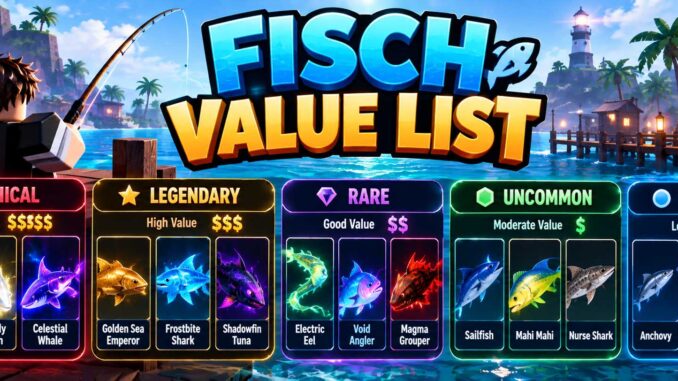
A reliable Fisch value list can help you decide whether a trade is fair before you accept it. Since Fisch has developed a large player-driven trading economy, rare fish, boats, cosmetics, relics, and limited collectibles can have very different values. However, those values are not permanently fixed, so smart players compare rarity, demand, availability, and recent trading activity before making a deal.
As of October 2026, several community value systems are being used to estimate Fisch items. Some lists compare items in Enchant Relics, while newer trading communities may use systems such as Proto or S$ estimates. Therefore, you should never assume that numbers from two different lists represent the same unit.
Instead, use a value list as a starting point. Then, check current demand before accepting a major trade.
How Does the Fisch Value List Work?
The Fisch value list estimates what players may be willing to exchange for fish, boats, cosmetics, relics, and other tradable collectibles.
Unlike an NPC selling price, trading value comes from player demand.
Therefore, two items that sell to an NPC for similar amounts can have completely different player-trading values.
For example, limited items may become valuable because players can no longer obtain them easily. Meanwhile, a technically rare item may trade poorly if few players actually want it.
Several factors influence value:
- Rarity
- Current availability
- Player demand
- Event exclusivity
- Item age
- Mutations or variants
- Supply
- Recent updates
- Collector interest
Because these factors can change, community prices should always be treated as estimates rather than guaranteed exchange rates.
Fisch Trading Value List: Popular High-Value Items
Current community lists use several valuation systems, which makes a single universal ranking difficult.
For instance, September 2026 community market data placed collectibles such as Puff of Heaven, Cthulu’s Revenge, Evangeline, Nocturne, and Curse IV among notable high-value items when using Proto-based comparisons.
Here is a simplified snapshot:
| Item | Approx. Proto Reference | General Market Status |
|---|---|---|
| Puff of Heaven | 7,200 | High-value collectible |
| Cthulu’s Revenge | 5,000 | High-value collectible |
| Evangeline | 2,250 | High demand |
| Nocturne | 1,775 | High demand |
| Curse IV | 1,625 | High demand |
| Cyanic Demonride | 1,500 | High demand |
| Scarwing | 1,200 | High demand |
| Heavyblade of Glory | 700 | High demand |
| Black Comet | 525 | Collector interest |
| The Reaper | 415 | High demand |
These figures are a September 2026 market snapshot rather than permanent prices. Therefore, confirm recent offers before using them for an expensive trade.
Likewise, never compare a Proto number directly with an Enchant Relic value unless you understand the conversion method being used by that particular community.
Why Rod Value and Rod Strength Are Different
New players sometimes assume that the strongest fishing rod must also have the highest trading value.
However, gameplay performance and collectible value are different concepts.
A rod can perform extremely well for fishing while another rod or rod skin becomes more desirable because it is limited, difficult to obtain, visually popular, or no longer readily available.
Therefore, before spending resources on fishing equipment, a fisch rod tier list can help you compare actual gameplay usefulness rather than judging rods purely by their collector-market value.
This distinction becomes especially useful for players who both fish and trade.
If your goal is faster progression, focus on performance. On the other hand, if your goal is collecting or trading, rarity and demand can matter more.
Popular Fish Values in Fisch
Fish values can become confusing because Fisch has both NPC sale values and player-trading values.
These are not the same thing.
NPC C$ values generally tell you what a catch is worth when sold through normal gameplay. In contrast, trading values estimate what another player might offer for a collectible fish.
Therefore, always check which value a guide is displaying.
Earlier 2026 community trading data listed examples such as:
| Fish | Reference Trading Range |
|---|---|
| Nessie | 180–200 Relics |
| Skeletal Nessie | 100–150 Relics |
| Phantom Megalodon | 55–70 Relics |
| Sea Leviathan | 55–65 Relics |
| Leviathan | 45–55 Relics |
| Reef Titan | 45–55 Relics |
| Pliosaur | 45–55 Relics |
| Ancient Megalodon | 32–42 Relics |
| Megalodon | 30–40 Relics |
| The Kraken | 25–30 Relics |
These ranges came from a July 2026 community snapshot. Consequently, they should not be treated as guaranteed October prices.
Still, they provide a useful example of how traders compare collectible fish using a common reference unit.
Fisch Boat Value List
Boats can sit among the most valuable collectibles in the Fisch trading economy.
However, value depends heavily on availability and collector demand.
Some limited boats can trade far above ordinary boats because players value their rarity, appearance, or event history.
A July 2026 Relic-based community list reported these reference ranges:
| Boat | Reference Value |
|---|---|
| Curse IV | 2,200–2,400 Relics |
| Nocturne | 1,750–1,950 Relics |
| Evangeline | 1,400–1,600 Relics |
| Black Comet | 1,300–1,400 Relics |
| Pastel Impulse | 900–1,000 Relics |
| Demonwake | 900–1,000 Relics |
| Kraken of the Void | 750–800 Relics |
| Elysian Jolt | 720–750 Relics |
| Violet Viper | 620–650 Relics |
| Curse III | 620–650 Relics |
Meanwhile, newer community systems can assign noticeably different relative figures because they use another valuation unit and more recent market data.
Therefore, when searching for a Fisch boat value list, always check both the date and the value unit before comparing offers.
Otherwise, two accurate-looking numbers can still represent completely different valuation systems.
Item and Relic Values in Fisch
Not every valuable trade involves a fish or boat.
Materials, relics, skins, cosmetics, and other collectibles can also develop meaningful trading demand.
For example, July 2026 community estimates valued Blessed Song around 65–75 Relics and Moonstone around 25–30 Relics. Meanwhile, several specialized Enchant Relics and Energy Crystals appeared around the mid-single-digit Relic range.
However, market demand matters as much as the reference number.
If an item has a listed value of 20 but very few players want it, finding someone willing to pay the full reference value may take time.
Conversely, a highly demanded item may attract overpay offers because multiple players want it.
Therefore, experienced traders usually evaluate both value and demand.
How Mutations and Variants Affect Fisch Values
A base item does not always have the same value as a special version of that item.
Mutations, variants, event characteristics, and other special attributes can influence collector interest.
Consequently, you should inspect the exact item being offered rather than searching only for its basic name.
For example, suppose a standard fish has modest demand. A desirable limited or mutated version may attract a much stronger offer.
However, the multiplier is not automatically identical across every item.
Demand still matters.
Therefore, before paying extra for a variant, compare recent trades involving that specific version whenever possible.
How to Tell Whether a Fisch Trade Is Fair
A value list makes comparison easier, but you still need to judge the complete offer.
First, calculate the approximate combined value on both sides.
Next, look at demand.
For example, imagine Player A offers one item valued around 100 units, while Player B offers several items totaling roughly 110.
At first, Player B’s offer looks better.
However, if those smaller items have weak demand, Player A may still own the easier item to trade later.
Therefore, consider these questions:
- What value system am I using?
- How recent are the values?
- Is the item currently obtainable?
- Is demand high or low?
- Does the item have a special variant?
- Are recent players actually trading near the listed value?
- Am I receiving one liquid item or several hard-to-trade items?
- Did an update recently change supply?
If several answers are unclear, wait before accepting.
Value vs Demand: Which Matters More?
Value tells you the estimated size of an item in the market.
Demand tells you how strongly other players want it.
Therefore, neither number works perfectly alone.
A high-value item with weak demand can be difficult to move. Meanwhile, a slightly lower-value item with strong demand may attract trades much faster.
For active traders, liquidity matters.
For collectors, however, demand may matter less because they may plan to keep the item permanently.
As a result, the “better” item depends on your goal.
If you plan to flip items, prioritize a combination of solid value and healthy demand. However, if you are building a collection, rarity and personal preference may matter more.
Beginner Trading Mistakes to Avoid
New traders often accept deals too quickly because the offer contains several items.
However, quantity does not automatically equal value.
Five low-demand items can easily be worse than one desirable collectible.
Likewise, avoid trusting someone simply because they claim an item is “rising.”
Instead, check recent value information yourself.
Another common mistake is confusing NPC C$ sale prices with player-trading values. Since those systems measure different things, comparing them directly can create misleading results.
Also, avoid relying on screenshots of old lists.
Values can move after events, updates, re-releases, or changes in supply.
Finally, never rush because another player says the offer expires in a few seconds. If you do not understand the trade, declining it is usually better than guessing.
Advanced Tips for Fisch Traders
Once you understand basic values, start watching market movement rather than individual numbers.
For instance, an event-exclusive collectible may initially have high supply because many players just obtained it.
Later, supply may tighten.
However, that does not guarantee the item’s value will rise because demand can also disappear.
Therefore, monitor both sides of the market.
You can also compare multiple value sources instead of relying on a single list. If several recent references show similar numbers, you have stronger evidence for a fair range.
Meanwhile, a large disagreement between value lists should make you more cautious.
Experienced traders also avoid converting all their inventory into low-demand collectibles. Keeping some popular, easily traded items can make future upgrades much easier.
What About the Fisch Value List 2027?
Players already searching for a Fisch value list 2027 should remember that 2027 values cannot be confirmed before those trades and updates actually happen.
As of October 2026, future patches, events, re-releases, new collectibles, and balancing decisions could change the market significantly.
Therefore, a 2026 value should never be presented as a guaranteed 2027 price.
Once 2027 arrives, traders should check newly updated lists and compare them with actual player demand.
This approach keeps your trading decisions based on current information rather than predictions.
Fisch Value List FAQs
What is the best Fisch value list to use?
No single community list guarantees the exact price of every trade. Therefore, use a recently updated list, understand its value unit, and compare the estimate with current player demand.
What does value mean in Fisch?
Trading value estimates what players may exchange for an item. However, NPC C$ sale value represents a different system and should not automatically be treated as player-trading value.
Why do Fisch value lists show different numbers?
Different lists may use different units, datasets, update dates, and community trading methods. Therefore, compare the methodology before comparing the actual numbers.
Do Fisch values change after updates?
Yes. New content, returning items, limited events, changes in availability, and shifts in player demand can influence trading values.
Are boats valuable in Fisch?
Some boats can have significant collector value, particularly limited or desirable ones. However, their exact trading value changes with supply and demand.
Is a higher-value item always a better trade?
Not necessarily. Demand, rarity, variants, and how easily you can trade the item again also matter.
Use Values as a Guide, Not a Guaranteed Price
The best way to use a Fisch value list is as a reference before negotiating, rather than treating every number as a fixed price. Community values move because players decide what they are willing to offer, while updates and events can change supply surprisingly quickly.
Therefore, check the date, confirm the value unit, compare demand, and inspect any mutations or variants before accepting an expensive trade.
Most of all, slow down when an offer looks unusually good or requires a large part of your inventory. A few extra minutes spent checking current values can help you avoid a poor trade and build a much stronger Fisch collection over time.