
If you’ve ever searched for the difference between rummy and gin rummy, you’re not alone. The two card games share the same family of mechanics, yet they play quite differently. Both involve forming sets and sequences, but the number of players, scoring system, and winning strategy make each game unique.
For beginners, the games can seem almost identical. Once you understand the rules, though, it becomes clear why some players prefer traditional while others enjoy the faster pace of gin rummy.
This guide explains the similarities and differences, compares their gameplay, and helps you decide which version suits your playing style.
What Is the Difference Between Rummy and Gin Rummy?
The easiest answer to what is the difference between rummy and gin rummy is that traditional is designed for multiple players, while is almost always played between two players.
Both games require players to create valid card combinations, called melds, before their opponents do. The biggest differences appear in how cards are laid down, how rounds end, and how points are counted.
Here’s a quick overview:
- Rummy supports multiple players.
- Gin rummy is primarily a two-player game.
- Rummy allows players to place melds on the table during play.
- Gin rummy keeps hands hidden until the round ends.
- Gin rummy places greater emphasis on reducing deadwood points.
Although the objective is similar, the pace and strategy feel very different.
Understanding Traditional Rummy
Rummy is a family of matching-card games where players collect cards to create:
- Sets (three or four cards of the same rank)
- Runs (three or more consecutive cards of the same suit)
The first player to meet the game’s winning conditions usually wins the round.
Depending on the variation, players may:
- Lay down melds throughout the game.
- Add cards to existing melds.
- Rearrange combinations.
- Play with two to six or more players.
Because several versions exist, house rules may differ slightly.
Players who enjoy learning multiple classic card games often move from rummy to titles like how to play canasta, since both reward planning, observation, and efficient card management.
What Is Gin Rummy?
Gin rummy is a streamlined version of created specifically for two players.
Instead of placing melds on the table throughout the round, players keep their hands hidden while trying to organize cards into complete sets and runs.
Each turn usually consists of:
- Drawing one card.
- Discarding one card.
The round ends when a player:
- Knocks with low deadwood points.
- Declares Gin with no unmatched cards.
Because information stays hidden until the end, reading your opponent becomes an essential part of the game.
Difference Between Rummy and Gin Rummy Rules
The difference between rummy and gin rummy becomes even clearer when comparing their rules.
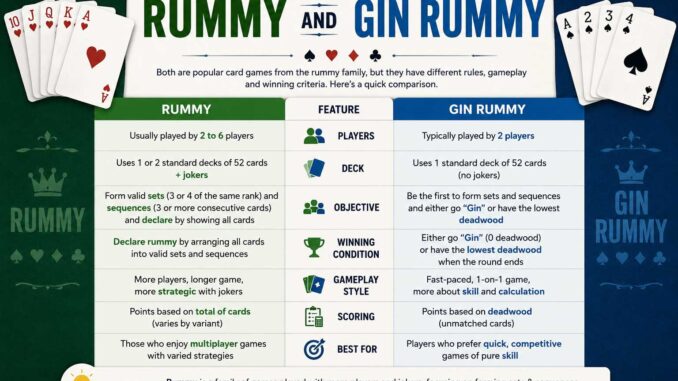
| Feature | Rummy | Gin Rummy |
|---|---|---|
| Players | 2–6+ | Usually 2 |
| Goal | Form valid melds | Form melds while minimizing deadwood |
| Melds | Can usually be placed during play | Stay hidden until the round ends |
| Winning | First to complete required combinations | Knock or declare Gin |
| Scoring | Varies by version | Based on deadwood points |
| Round Length | Often longer | Usually faster |
This comparison explains why gin is commonly chosen for quick head-to-head matches.
Similarities Between Both Games
Despite their differences, both games share several core mechanics.
Players in each game:
- Draw one card each turn.
- Discard one card.
- Build runs and sets.
- Watch opponents’ discards.
- Plan several turns ahead.
These shared mechanics explain why players can often switch between the two games without starting completely from scratch.
Why Gin Rummy Feels More Strategic
Many experienced players believe requires stronger tactical decision-making.
Since opponents cannot see your melds, every discarded card provides valuable information.
Players constantly ask themselves:
- Which cards is my opponent collecting?
- Should I keep a risky high-value card?
- Is it better to knock now or wait for Gin?
- Will this discard help my opponent?
The hidden information creates psychological battles that aren’t always present in traditional multiplayer rummy.
What’s the Difference Between Rummy and Gin Rummy for Beginners?
If you’re wondering what’s the difference between rummy and gin rummy from a beginner’s perspective, the answer comes down to complexity and player count.
Traditional rummy is often easier to learn in social settings because players can see melds placed on the table.
Gin rummy asks beginners to track more hidden information, making memory and observation more valuable.
That doesn’t necessarily make gin rummy harder. It simply rewards different skills.
Scoring Systems Compared
Scoring is one of the biggest differences between the games.
Rummy Scoring
Many rummy variations calculate scores based on:
- Remaining cards
- Declared combinations
- Game-specific rules
Different versions may award points differently.
Gin Rummy Scoring
Gin rummy focuses heavily on deadwood.
Deadwood consists of unmatched cards remaining in your hand.
Players score by:
- Knocking with low deadwood.
- Declaring Gin with no deadwood.
- Earning bonus points for achieving Gin.
Because every unmatched card matters, players often make different decisions than they would in traditional rummy.
Choosing the Right Game for Your Group
The best version depends on who you’re playing with.
Choose traditional rummy if you:
- Have three or more players.
- Prefer longer social games.
- Enjoy building visible melds.
- Like flexible rule variations.
Choose gin rummy if you:
- Want a competitive two-player game.
- Enjoy hidden information.
- Prefer quicker rounds.
- Like tactical decision-making.
Neither version is objectively better. Each offers a different style of challenge.
Beginner Tips Before Your First Match
New players often improve quickly by following a few simple habits.
Watch the Discard Pile
Every discarded card reveals information.
Even if you don’t need a particular card, your opponent might.
Don’t Hold High Cards Too Long
Face cards can become expensive if they’re left unmatched at the end of the round.
Removing risky cards early often reduces your potential penalty.
Think Two or Three Turns Ahead
Strong players don’t focus only on the current draw.
Instead, they plan multiple possible combinations based on future cards.
This habit becomes especially valuable in , where every discard can influence your opponent’s strategy.
Why Both Games Remain Popular
Rummy and gin have remained popular for generations because they combine luck with meaningful decision-making.
Random card draws keep every game fresh, while strategy, observation, and timing reward experienced players.
Whether you’re playing casually with family or competing against skilled opponents, both games offer enough depth to remain enjoyable after hundreds of matches.
Advanced Strategy: How the Games Reward Different Skills
Once you understand the rules, the difference between gin rummy and rummy becomes more noticeable through strategy rather than mechanics.
Traditional rummy rewards players who can:
- Build multiple melds at the same time.
- Adapt to changing cards on the table.
- Watch several opponents instead of one.
- Decide when to reveal combinations for maximum advantage.
Gin rummy, by contrast, is built around hidden information.
Strong players focus on:
- Predicting an opponent’s hand.
- Controlling the discard pile.
- Managing deadwood efficiently.
- Choosing the perfect moment to knock.
Because every card matters, small decisions often determine who wins the round.
Common Mistakes Beginners Make
New players tend to repeat the same errors regardless of which version they choose.
Keeping High-Value Cards Too Long
Kings, Queens, and Jacks can become costly if they remain unmatched.
If they don’t fit into a likely meld, it’s often better to discard them before they become a liability.
Ignoring Opponent Discards
Many beginners focus only on their own cards.
Those choices reveal valuable clues about potential runs and sets.
Chasing Too Many Combinations
Trying to complete several possible melds at once usually leaves your hand scattered.
Focus on the combinations that are most likely to succeed.
Knocking Too Late in Gin Rummy
Waiting for a perfect hand sometimes gives your opponent enough time to finish first.
Learning when to knock is just as important as knowing when to keep playing.
Which Game Matches Your Strategy and Playing Style?
Your ideal choice comes down to the playing experience you prefer.
| Player Preference | Better Choice |
|---|---|
| Family game night | Rummy |
| Competitive head-to-head matches | Gin Rummy |
| Larger groups | Rummy |
| Quick games | Gin Rummy |
| Hidden-information strategy | Gin Rummy |
| Flexible house rules | Rummy |
Neither game replaces the other. Instead, each offers a different style of card-playing experience.
Improving Your Win Rate
Winning consistently requires more than knowing the rules.
Learn Card Probabilities
You won’t know every remaining card, but estimating which ranks and suits are still available helps you make smarter decisions.
Stay Flexible
Sometimes your original plan stops working.
If the cards don’t cooperate, switch to a different run or set instead of forcing one combination.
Watch Your Opponent’s Behavior
Even casual players leave patterns.
Notice:
- Which cards they immediately discard.
- Which suits they seem to collect.
- Whether they draw from the stock pile or the discard pile.
These observations become especially valuable in rummy.
Practice Short Sessions
Playing several shorter games often improves your decision-making faster than one long session because you experience more opening hands and endgame situations.
How Luck and Skill Balance Each Other
Still, experienced players consistently outperform beginners because they:
- Make better discard choices.
- Recognize stronger meld opportunities.
- Minimize deadwood more effectively.
- Adapt when their original strategy fails.
That’s why tournaments remain competitive despite the random nature of the deck.
Similar Card Games You Might Enjoy
If you enjoy matching-card games, there are plenty of other classics worth trying.
Players who like building combinations often move on to learning how to win solitaire, where planning several moves ahead is just as valuable, even though it’s played solo.
For groups looking for something more social and unpredictable, ride the bus rules offer a completely different card game experience built around chance, memory, and lighthearted challenges rather than strategic melding.
Exploring different card games can strengthen skills such as probability, observation, and decision-making while keeping game nights fresh.
Frequently Asked Questions
Is gin rummy harder than regular rummy?
Not necessarily. Gin rummy has simpler rules in some areas, but it demands stronger observation and hand management because all melds remain hidden until the round ends.
Can more than two people play gin rummy?
Standard is designed for two players. Traditional rummy is a better option for larger groups.
Which game is faster?
Gin rummy usually has shorter rounds because only two players participate and the winning conditions are straightforward.
Does regular rummy always use the same rules?
No. There are many popular variations around the world, each with slightly different scoring systems, melding rules, and winning conditions.
Which game is better for beginners?
If you’ll mostly play against one other person, gin rummy is a great choice once you’re comfortable tracking hidden information.
Final Takeaways
Understanding the difference between rummy and gin rummy makes it much easier to choose the right game for your next card session. While both games share the same foundation of creating runs and sets, they reward different skills.
Traditional rummy shines in multiplayer settings where visible melds, flexible rules, and social interaction take center stage. , on the other hand, offers a faster, more tactical experience where hidden hands, careful discards, and efficient deadwood management decide the winner.
If you’re new to card games, try both versions. Either way, both games have stood the test of time because they combine accessible rules with enough depth to keep players coming back for another round.