
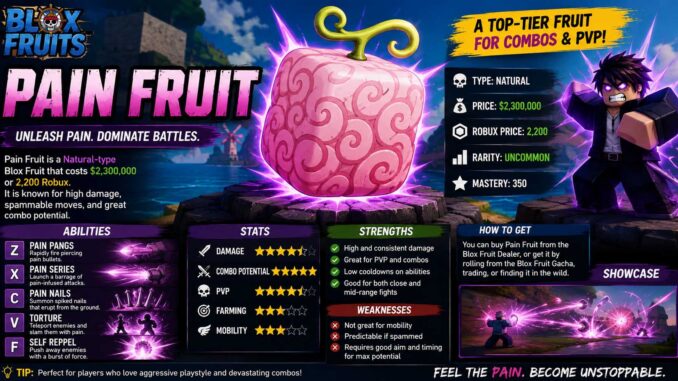
The Pain Fruit Blox Fruits players use today is very different from the simple ranged fruit many longtime fans remember. Formerly known as Paw, Pain is now a Legendary Natural-type fruit built around aggressive energy attacks, Pain Ghosts, a Pain Meter, and a powerful Last Stand mechanic. It can deal heavy damage and create dangerous PvP pressure, although its high mastery requirements and aim-dependent attacks mean it takes practice to use well.
For players deciding whether to buy, trade for, or eat Pain, the biggest question is not simply whether it is strong. Instead, you need to consider your level, preferred game mode, mechanical skill, and willingness to unlock its higher-mastery abilities.
What Is Pain Fruit in Blox Fruits?
Pain is a Legendary Natural-type Blox Fruit. At the Blox Fruit Dealer, its listed price is 2,300,000 Beli or 2,200 Robux for the permanent version. However, dealer prices and player-to-player trading values are different, so you should not treat the shop price as its guaranteed trade value.
Pain specializes in ranged energy attacks, crowd control, mobility, and PvP pressure. Meanwhile, its newer mechanics reward players for managing the Pain Meter and collecting Pain Ghosts instead of simply spamming abilities whenever their cooldowns finish.
If you are comparing several fruits and wondering what is the best fruit in blox fruits, consider your playstyle first. A fruit that dominates PvP may still be less convenient for leveling or casual grinding.
Pain particularly suits players who enjoy technical combat and active ability management.
Pain Fruit Blox Fruits Moves and Mastery Requirements
Pain’s current moveset includes an M1 attack plus five abilities. Therefore, players have more combat options than they would with a fruit that relies only on cooldown-based skills.
Here is a quick reference:
| Control | Move | Mastery |
|---|---|---|
| M1/Tap | Raging Rush | 1 |
| Z | Fury Jab | 1 |
| F | Torment Warp | 50 |
| X | Rage Release | 100 |
| C | Agony Nuke | 200 |
| V | Torturing Pulse | 300 |
These mastery requirements matter because Pain does not reveal its full potential immediately. While beginners can use its basic attacks early, the strongest parts of the kit require substantial mastery.
Raging Rush
Raging Rush gives Pain an M1-based attack sequence. Normally, the user rushes into a series of punches before finishing with an energy barrage.
However, the move becomes far more threatening during Last Stand. Its hitboxes, speed, damage, and stun potential increase, which makes close-range pressure much more dangerous.
Fury Jab
Fury Jab unlocks at just 1 mastery, so players can start using it almost immediately.
When tapped, it launches a Pain Ghost projectile. Meanwhile, holding the ability produces a barrage. Because the move rewards accurate positioning and can interact with Pain Ghost mechanics, experienced players can get considerably more value from it than beginners.
Rage Release
At 100 mastery, Rage Release introduces another aggressive movement option. The tapped version dashes into an opponent and starts a short attack sequence.
In contrast, the held version can carry the target upward before launching an energy beam. As a result, it works well as a follow-up when you have already created an opening.
Agony Nuke
Agony Nuke becomes available at 200 mastery.
Its tapped version fires concentrated energy that can pull nearby enemies before exploding. With the appropriate upgrade, its held form can instead produce a large energy beam.
Therefore, this move gives Pain both offensive pressure and useful crowd-control potential.
Torturing Pulse
Torturing Pulse requires 300 mastery, making it one of Pain’s later unlocks.
The tapped version launches a fast attack that causes repeated damage and visual disruption. Meanwhile, its held version can cover a larger area and pull an enemy forward, although it requires more commitment.
Consequently, timing matters. Using the held attack carelessly can leave you vulnerable.
Torment Warp
Torment Warp unlocks at 50 mastery and provides mobility.
The basic version launches the character forward, while its upgraded held variation provides more flexible directional movement. Pain Ghosts can also reset Torment Warp’s cooldown, which creates interesting movement opportunities for experienced players.
Understanding the Pain Meter and Last Stand
The defining feature of the modern Blox Fruits Pain Fruit is its Pain Meter.
The meter fills through damage taken and interactions with Pain Ghosts. Once filled, it can improve parts of Pain’s combat performance, including movement and cooldown behavior. Therefore, managing the meter becomes part of your fighting strategy rather than a passive background mechanic.
Pain Ghosts are equally useful. Certain missed attacks create them, and collecting these ghosts helps fill the Pain Meter. They can also interact with Torment Warp and, after specific upgrades, gain offensive utility.
Why Last Stand Changes PvP
Last Stand activates when the Pain user loses all health under the required conditions.
Instead of immediately ending the fight, Pain enters a temporary powered state. During this period, movement improves, cooldowns become much shorter, damage resistance increases, and Pain’s M1 attacks become significantly stronger. However, the player becomes restricted to Pain abilities and dies when the temporary state expires.
So, Last Stand should not be treated as unlimited revival.
Rather, think of it as one final window to finish your opponent, escape danger, or completely reverse a fight.
Is Pain Fruit Good for PvP in 2026?
Yes, Pain can be a strong PvP fruit, particularly in skilled hands.
Its range allows you to pressure opponents without constantly standing beside them. Meanwhile, its mobility, stuns, Pain Ghost mechanics, and Last Stand give experienced users several ways to disrupt predictable opponents. Current community references generally rate PvP among Pain’s strongest uses.
Still, Pain is not effortless.
Several abilities require accurate aim, while held attacks can expose you if an opponent anticipates them. Aerial targets can also be difficult to hit consistently. Therefore, a player who switches from an easier fruit may initially find Pain weaker than expected.
Simple PvP Approach
Start by learning the range and timing of each move instead of trying complicated combos immediately.
First, use your ranged attacks to force movement. Next, capitalize on an opening with Rage Release or another control option. Then, use mobility to reposition rather than remaining directly in front of the opponent.
Meanwhile, keep an eye on your Pain Meter. Once Last Stand becomes relevant, your priorities change because you have only a limited period to capitalize on its buffs.
This playstyle rewards patience followed by sudden aggression.
Is Pain Fruit Good for Grinding?
Pain can grind NPCs, but it is not necessarily the easiest fruit for leveling.
Its current kit offers multi-target attacks and strong damage, yet its mastery requirements create an obvious barrier for lower-level players. Some attacks also involve knockback, which can make tightly grouping NPCs less convenient.
Therefore, Pain makes more sense for someone who already wants to master the fruit than for a new player seeking the simplest possible leveling option.
If you do grind with it, try fighting enemies near walls or other solid objects. This reduces the inconvenience caused by knockback and can make follow-up attacks easier.
Meanwhile, prioritize unlocking the 100, 200, and 300 mastery abilities. Once your full moveset becomes available, Pain feels much more complete.
Blox Fruits Pain Fruit Rework and Upgrades
Players searching for the Blox Fruits Pain Fruit rework should understand that current Pain includes mechanics and upgrade options that older Paw/Pain guides may not describe accurately.
For example, current versions include Raging Rush, Pain Ghosts, the Pain Meter, Last Stand, and upgradeable abilities. Therefore, old guides showing moves such as the historical Paw-era kit can be misleading for current gameplay.
Pain can also receive upgrades through the Admin Panel system. These upgrades improve specific mechanics, including Last Stand duration and enhanced versions of certain attacks.
However, fully developing Pain requires considerable mastery and upgrade resources. Consequently, players should view it as a fruit that grows stronger with investment rather than something whose full potential appears immediately after eating it.
Blox Fruits Pain Fruit Tier List 2026: Where Does It Fit?
A universal Blox Fruits Pain Fruit tier list 2026 position is difficult to give because tier rankings depend heavily on what you are measuring.
For PvP, Pain deserves much more respect than its difficulty might initially suggest. Its combination of damage, range, mobility, control, and comeback potential can make it threatening.
For straightforward grinding, however, easier alternatives may offer smoother progression with less mechanical effort.
A practical rating looks like this:
| Category | Practical Rating | Why |
|---|---|---|
| PvP | Very Good | Range, stuns, mobility and Last Stand |
| Damage | Very Good | Strong attacks with high offensive potential |
| Mobility | Good | Torment Warp supports repositioning |
| Grinding | Decent | Useful attacks but demanding mastery |
| Beginner Ease | Below Average | Requires aim and mechanic management |
| Combo Potential | Very Good | Multiple attacks can create follow-ups |
These ratings are best treated as gameplay guidance rather than fixed rankings because balance changes and player skill can shift a fruit’s practical performance.
Best Pain Fruit Build and Playstyle
A fruit-focused build makes sense if Pain is your primary source of damage.
However, stat allocation depends on your level and whether you rely heavily on swords, guns, or fighting styles. Therefore, copying an endgame player’s build while you are still progressing can leave your character poorly balanced.
For a fruit-main approach, prioritize strong Blox Fruit damage while keeping enough investment in Defense and Melee to support survivability and energy.
Meanwhile, advanced PvP players can combine Pain with a fighting style or weapon that complements its control options. The goal is not to equip the highest-damage item available. Instead, choose tools that help cover Pain’s openings or extend the pressure created by its abilities.
Common Pain Fruit Mistakes
One common mistake is holding attacks for too long. Although charged abilities can become powerful, experienced opponents may punish the startup.
Another mistake is ignoring Torment Warp. Mobility is part of Pain’s strength, so using the fruit purely as a stationary ranged attacker wastes part of its kit.
Likewise, do not treat Last Stand as permission to attack randomly. Since the state has a limited duration, every second matters.
Finally, avoid judging Pain before unlocking enough mastery. A partially unlocked Pain kit cannot show what the fruit can really do.
Pain Fruit Blox Fruits FAQs
Is Pain Fruit a Legendary fruit?
Yes. Pain is currently classified as a Legendary Natural-type Blox Fruit.
How much does Pain Fruit cost?
Its Blox Fruit Dealer price is currently listed at 2,300,000 Beli, while permanent Pain costs 2,200 Robux. Trading values are separate and can change with player demand.
Is Pain Fruit good for beginners?
It can work for beginners, but it is not one of the simplest fruits to master. Its high mastery requirements, aiming demands, meter management, and charged abilities reward experienced players more strongly.
Does Pain Fruit have M1 attacks?
Yes. The current Pain moveset includes Raging Rush as its M1/Tap attack.
Is Pain better for PvP or grinding?
Pain generally shines more clearly in PvP because its range, mobility, control tools, and Last Stand can reward skilled combat. Grinding is possible, although easier fruits may be more convenient for players focused purely on fast progression.
Should You Use Pain Fruit?
Pain is worth considering if you enjoy technical fruits that reward practice. It offers strong damage, ranged pressure, mobility, unusual Pain Ghost mechanics, and a Last Stand system that can turn a losing battle into one final offensive opportunity.
However, players who mainly want effortless grinding may prefer a simpler option. Pain asks you to aim carefully, manage its mechanics, unlock substantial mastery, and understand when to attack or reposition.
For PvP-focused players, though, that complexity is exactly what makes Pain Fruit Blox Fruits interesting. Learn the range of each move first, master Pain Ghost and meter management next, and then build your combos around the openings you consistently create.