
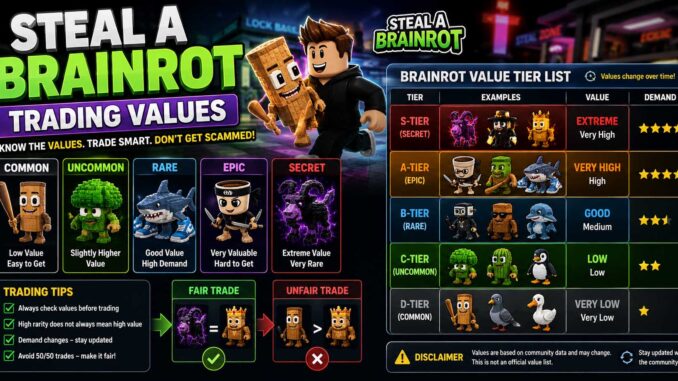
You finally get a trade offer for one of your rare Brainrots, but there is one problem: how do you know whether it is actually fair? Steal a Brainrot trading values give players a practical way to compare Brainrots before accepting an exchange. However, value is not determined by rarity alone. Demand, exist count, mutations, traits, income, availability, and recent game updates can all change what players are willing to offer.
That makes trading a little more complicated than comparing two names on a list. Fortunately, once you understand what creates value, spotting obvious wins, fair trades, and bad deals becomes much easier.
As of August 2026, community value trackers can follow hundreds of Brainrots while showing changes in value, demand, and market trends. Still, these figures are community references rather than guaranteed official prices.
What Are Steal a Brainrot Trading Values?
A trading value is an estimated measure of what one Brainrot is worth compared with other Brainrots.
Think of it as a shared reference point.
If players regularly exchange a certain Brainrot for similar high-tier collectibles, its community value begins to reflect those trades. Meanwhile, if nobody wants an item despite its rarity, its practical trading power may remain weak.
Therefore, a value list does not work like a fixed shop price.
Community trading guides specifically describe values as reference points rather than official prices. In other words, they help players compare offers, but they do not force another player to accept a particular valuation.
This system will feel familiar to Roblox players who already follow grow a garden trade values, since both types of player economies depend heavily on supply and demand rather than one permanent number.
What Determines Steal a Brainrot Trading Values?
Several factors work together when players decide whether a Brainrot deserves a strong offer.
Rarity
Rarity provides a useful starting point because harder-to-obtain Brainrots generally attract more attention.
However, rarity should never be your only measurement. Two Brainrots in a similar rarity range can have very different trading demand.
For that reason, experienced traders continue checking other factors before accepting.
Exist count
Exist count measures how many copies of a Brainrot are known to exist.
Generally, lower supply can increase collector interest because fewer copies are available. Yet scarcity does not automatically create demand.
A very scarce Brainrot that few players want can still be difficult to trade.
Meanwhile, a popular character with somewhat higher supply may receive better offers because more players actively chase it.
Player demand
Demand is one of the biggest reasons trading values move.
For example, a Brainrot can suddenly become popular after an update, creator video, event, or shift in the trading community. Consequently, offers may increase even though the item itself has not changed.
Current August 2026 value tracking illustrates this clearly. Some tracked Brainrots show rising values while others show declining trends, which demonstrates why old lists can become unreliable.
Income generation
Brainrots also generate in-game income, so earnings can influence desirability.
Still, you should not assume that the highest income always means the highest trade value. Collectors may care more about rarity, mutations, limited availability, or prestige.
As a result, income is one part of valuation rather than the entire formula.
How Mutations Change Trading Values Steal a Brainrot Players Use
Mutations can significantly change how traders view an otherwise ordinary Brainrot.
A base version and a desirable mutated version should not automatically receive identical offers. Community calculators therefore let players select mutations separately when evaluating a trade.
However, avoid multiplying the base value blindly.
Community trading systems may apply their own premiums because actual player demand does not always match an item’s raw income multiplier. One current calculator, for example, explicitly separates trade premiums from simple income multipliers.
So, when evaluating a mutated Brainrot, ask:
- How desirable is the mutation?
- Does it noticeably improve income?
- How commonly does that combination appear?
- Are traders actively looking for it?
- Does the current calculator account for the mutation?
Those questions give you a much better estimate.
Traits Can Make Two Identical Brainrots Worth Different Amounts
Traits create another layer of variation.
Suppose two players own the same Brainrot with the same base rarity. One has desirable traits while the other has none. Although their names match, the community may value them differently.
Some current calculators allow players to select individual traits and calculate bonuses on top of mutation values.
Yet buyer preference still matters.
One trader may specifically want a particular trait combination, while another may care mostly about scarcity. Therefore, calculator results should guide negotiations rather than replace them.
The same principle appears in a grow a garden trade, where the exact characteristics of an item or pet can matter as much as its basic identity.
Steal a Brainrot Trading Values New Updates Can Change Quickly
Never assume last month’s values are still correct.
New Brainrots can change demand for older collectibles. Meanwhile, limited events can remove acquisition methods, which may make existing copies harder to obtain.
Updates can also introduce new traits, mutations, machines, or trading behavior.
For example, the Trade Machine arrived in February 2026 as an in-game system for exchanging Brainrots. It supports trades through the game rather than forcing players to rely on trust-based exchanges arranged elsewhere.
Therefore, always check when a value list was last updated.
A guide from several months ago may still explain the trading system well, but its individual values may no longer reflect today’s market.
How to Judge W/F/L Trades
W/F/L means Win, Fair, or Loss.
It is one of the easiest ways to describe a trade.
| Result | Meaning | What It Suggests |
|---|---|---|
| W | Win | You receive noticeably stronger value |
| F | Fair | Both offers are reasonably close |
| L | Loss | You give noticeably more value |
| Small W | Slight Win | Your side gains a modest advantage |
| Small L | Slight Loss | You overpay somewhat, but it may still suit you |
However, a mathematical loss is not always a bad decision.
Suppose you trade a declining item for a slightly lower-valued Brainrot with excellent demand. You may accept a small numerical loss because the new item could be much easier to trade later.
Likewise, collectors sometimes overpay for the last Brainrot they need.
Therefore, W/F/L is a decision aid, not a rulebook.
How to Use a Steal a Brainrot Values Trading Calculator
A Steal a Brainrot values trading calculator can save time when several Brainrots, mutations, and traits are involved.
Current calculators generally let you build two sides of a trade and compare their estimated totals. Some also support mutations, traits, quantities, income calculations, and W/F/L results.
Step 1: Add your Brainrots
Start by entering every Brainrot you are offering.
Do not forget duplicates because quantity changes the total.
Step 2: Choose the correct variants
Next, select mutations and traits when the calculator supports them.
Using the base version instead of your actual variant can produce a misleading result.
Step 3: Add the other player’s offer
Enter every item you would receive.
Then, compare the totals rather than focusing on the most impressive-looking Brainrot.
Step 4: Check demand separately
Now look beyond the number.
Ask whether the Brainrots you receive are easy to trade again. A technically fair offer filled with low-demand collectibles may be less useful than a slightly smaller offer containing a highly liquid item.
Step 5: Verify before confirming
Finally, inspect the actual in-game trade window.
Make sure every Brainrot, mutation, trait, and quantity matches what you agreed to receive.
This extra check takes seconds and can prevent an expensive mistake.
Why Different Trading Calculators Give Different Values
You may notice that one calculator says a trade is fair while another says you are losing.
That does not necessarily mean one is broken.
Community calculators can use different valuation systems. For example, one tool bases rare items on market averages before applying mutation and trait adjustments, while another uses community reference units such as Dragons and Garama.
As a result, their totals can differ.
This is similar to comparing more than one grow a garden trading value source. The smartest approach is to look for agreement across recent data rather than treating one calculator as absolute truth.
Steal a Brainrot Trading Values Free Tools vs Paid Information
You do not need to pay simply to understand whether a normal trade looks reasonable.
Several Steal a Brainrot trading values free resources provide value lists or calculators that players can use as reference points. For example, community tools currently offer free W/F/L comparisons and searchable value databases.
Still, free does not automatically mean accurate.
Before trusting a tool, check its last update date, methodology, supported mutations, trait handling, and whether it clearly labels values as estimates.
Avoid any service that claims its number guarantees a trade outcome.
Players decide what they are willing to exchange, so no calculator controls the live market.
Common Trading Mistakes Beginners Make
The biggest beginner mistake is checking rarity and nothing else.
A rare Brainrot can still have poor demand.
Another common mistake is using outdated values. Since community prices move, an old screenshot may lead you to overpay badly.
Likewise, some players compare base versions while forgetting mutations and traits.
You should also avoid accepting immediately because someone says their offer is “overpay.” Instead, calculate both sides yourself.
Meanwhile, don’t assume a bundle of ten mediocre Brainrots automatically beats one strong collectible. Quantity and quality are different things.
A grow a garden value list serves a similar purpose in another Roblox economy: organized reference data helps, but players still need to understand what the market actually wants.
Advanced Trading Strategies for Better Deals
Once you understand basic values, start watching trends.
Trade for demand, not just numbers
High-demand Brainrots are usually easier to move.
Therefore, accepting a slightly lower numerical value can sometimes make sense if you receive an item with much stronger liquidity.
Avoid holding rapidly falling items
If demand starts disappearing after an event or hype cycle, consider whether keeping the Brainrot still fits your collection goals.
However, don’t panic after every small value adjustment.
Learn common reference items
Active traders often compare unfamiliar Brainrots against well-known high-demand items or community units.
Learning these benchmarks makes it easier to judge offers without constantly opening a calculator.
Keep collection and trading goals separate
A collector may happily overpay for a favorite Brainrot.
A value-focused trader probably will not.
Neither approach is wrong, but knowing your goal prevents regret afterward.
Safer Trading in Steal a Brainrot
Whenever possible, use the supported in-game trading system.
The Trade Machine was introduced specifically to make exchanges safer than trust-based arrangements where one player transfers something first and hopes the other player follows through.
Before confirming, read both sides carefully.
Also, avoid pressure tactics such as “accept now or I leave.” A fair deal should survive a few seconds of verification.
Never assume a screenshot proves an item’s current value either. Search recent information yourself.
Most of all, remember that a calculator estimates value; it does not protect you from clicking the wrong trade.
FAQs About Steal a Brainrot Trading Values
Are Steal a Brainrot trading values official?
Generally, no. Community value lists and calculators provide estimated reference values rather than official guaranteed prices.
What makes a Brainrot valuable?
Rarity, exist count, player demand, availability, income, mutations, traits, and recent market activity can all affect value.
What does W/F/L mean?
W means Win, F means Fair, and L means Loss. Players use these labels to quickly describe whether an exchange favors one side.
Should I trust a trading calculator?
Use it as a reference, especially for complicated trades. However, compare current demand and recent values before accepting because calculators cannot perfectly predict what individual players will offer.
Do Steal a Brainrot values change after updates?
Yes. New content, changing availability, community demand, and trading trends can move values. Current trackers already show individual Brainrots rising, falling, or remaining stable over time.
Make Better Trades Without Chasing Every Value Change
Learning Steal a Brainrot trading values is less about memorizing hundreds of numbers and more about understanding why those numbers move. Start with a current value reference, then check demand, exist count, mutations, traits, income, and availability before deciding.
For expensive trades, compare both sides with a recent calculator and inspect every item again inside the Trade Machine. Meanwhile, keep an eye on demand rather than reacting to every tiny market movement.
Once you build that habit, W/F/L decisions become faster, safer, and far easier to understand.