
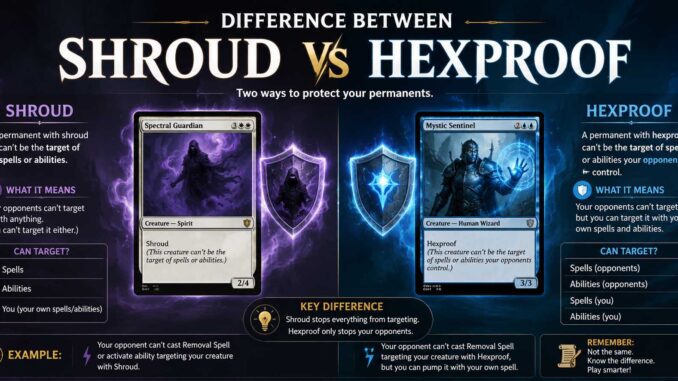
If you’ve ever asked about the difference between shroud and hexproof, you’re not alone. These two keyword abilities in Magic: The Gathering seem almost identical at first glance because both protect permanents from targeted spells and abilities. However, one small rules difference completely changes how they’re used in deck building and gameplay.
Understanding these mechanics can help you avoid costly mistakes, improve your sequencing, and choose the right cards for your strategy. Whether you’re a new player learning MTG’s rules or a veteran refining a Commander deck, this guide explains everything you need to know.
Difference Between Shroud and Hexproof at a Glance
Here’s the simplest way to remember it:
- Shroud: Nobody can target the permanent—not you and not your opponents.
- Hexproof: Only your opponents are prevented from targeting it. You can still target your own permanent.
That single distinction makes Hexproof much more flexible in modern Magic.
| Ability | You Can Target It | Opponent Can Target It |
|---|---|---|
| Shroud | ❌ No | ❌ No |
| Hexproof | ✅ Yes | ❌ No |
If you remember only one thing from this article, remember this table.
What Is Shroud?
Shroud is an older evergreen keyword ability.
A permanent with Shroud cannot be the target of any spell or ability.
That restriction applies equally to every player.
For example:
- You cannot cast Giant Growth on your own Shroud creature.
- Your opponent cannot cast Murder targeting it.
- You cannot equip it after it gains Shroud because Equip targets.
- You cannot enchant it with an Aura that targets while being cast.
Once a creature has Shroud, everyone must respect the restriction.
What Is Hexproof?
Hexproof was introduced to solve many of the gameplay frustrations created by Shroud.
A permanent with Hexproof cannot be targeted by spells or abilities your opponents control.
You still control your own creature normally.
That means you can:
- Cast pump spells.
- Equip Equipment.
- Attach Auras.
- Activate abilities targeting your creature.
Meanwhile, your opponents still cannot target it with removal spells like:
- Go for the Throat
- Doom Blade
- Path to Exile
- Lightning Bolt
This flexibility explains why Hexproof became much more common in modern card design.
Difference Between Hexproof and Shroud
The difference between hexproof and shroud becomes much clearer in actual gameplay.
Imagine you control a creature.
Scenario 1: The Creature Has Shroud
You want to:
- Equip Sword of Fire and Ice
- Cast Giant Growth
- Protect it with another spell
None of those work because your own spells and abilities target the creature.
Scenario 2: The Creature Has Hexproof
Now imagine the creature has Hexproof instead.
You can:
- Equip Equipment
- Cast buffs
- Target it with beneficial abilities
Only your opponents lose the ability to target it.
That creates far more strategic options.
Why Did Wizards of the Coast Create Hexproof?
Shroud often created awkward gameplay.
Players wanted to protect their creatures while still interacting with them.
Hexproof solved that issue.
Instead of preventing everyone from targeting a permanent, Hexproof protects only against opposing interaction.
As a result:
- gameplay became smoother,
- creature-based strategies improved,
- players had greater flexibility.
Today, Shroud appears much less frequently than Hexproof.
Common Examples
Creatures With Shroud
Some famous examples include:
- True-Name Nemesis (protection rather than Shroud, often compared)
- Troll Ascetic (older wording evolved into Hexproof)
- Simic Sky Swallower
- Invisible Stalker (actually Hexproof, often confused)
Older MTG sets contain most Shroud cards.
Creatures With Hexproof
Popular examples include:
- Gladecover Scout
- Slippery Bogle
- Carnage Tyrant
- Thrun, Breaker of Silence (modern versions vary by card)
Many Commander staples also feature Hexproof.
What’s the Difference Between Shroud and Hexproof During Combat?
Neither keyword changes combat directly.
Both abilities only affect targeting.
Combat damage still works normally.
For example:
- Hexproof creatures still take combat damage.
- Board wipes still destroy them if applicable.
Many beginners mistakenly believe Hexproof makes a creature invincible.
It doesn’t.
Spells That Still Work Against Hexproof
Hexproof only stops targeting.
It doesn’t stop effects that avoid the word “target.”
Examples include:
Board Wipes
Cards like:
- Wrath of God
- Damnation
- Supreme Verdict
destroy creatures without targeting them.
Sacrifice Effects
Cards saying:
“Each opponent sacrifices a creature.”
also bypass Hexproof because no target is chosen.
Global Damage
Effects dealing damage to every creature also ignore Hexproof.
Understanding these interactions makes you much harder to surprise during games.
Why Shroud Can Sometimes Hurt You
Although protection sounds powerful, Shroud has drawbacks.
Suppose you control:
- a 5/5 creature,
- Giant Growth,
- an Equipment.
If the creature has Shroud, you can’t improve it using your own cards.
In aggressive decks, that limitation can become frustrating.
Many players therefore prefer Hexproof whenever possible.
What’s the Difference Between Hexproof and Shroud in Commander?
Commander games often last longer.
Because of that:
- Equipment matters more.
- Auras appear more often.
- Protective instants see regular play.
Hexproof works especially well in Commander because you can continue building around your commander while opponents struggle to remove it.
Shroud, on the other hand, sometimes interferes with your own game plan.
Beginner Tips
If you’re learning Magic, remember these rules:
Hexproof protects against opponents.
Shroud protects against everyone.
Board wipes ignore both.
Equipment targets.
Most Auras target while being cast.
Keeping those five ideas in mind prevents many common mistakes.
Advanced Gameplay Tips
Experienced players can gain additional advantages.
Sequence Equipment First
If your creature will gain Shroud later, equip it before Shroud becomes active whenever possible.
Watch Temporary Effects
Some spells grant Shroud only until end of turn.
During that window, even you lose the ability to target the creature.
Know Stack Interactions
Hexproof doesn’t counter a spell already on the stack.
Instead, if a spell loses its legal target before resolving, it usually fizzles because all targets became illegal.
Learning priority and stack interactions makes these abilities even stronger.
Common Rules Questions
Can I Enchant a Hexproof Creature?
Yes.
As long as you control the Aura and cast it targeting your own creature.
Can I Enchant a Shroud Creature?
Usually no.
Casting an Aura targets the permanent during the casting process.
Can I Equip a Hexproof Creature?
Yes.
Equip abilities target creatures you control.
Since Hexproof only restricts opponents, Equip works normally.
Can I Equip a Shroud Creature?
No.
Equip explicitly targets.
Because of that, the ability cannot legally target a creature with Shroud.
Similar Abilities Worth Knowing
While learning MTG, you’ll encounter several protective keywords.
These include:
- Ward
- Protection
- Indestructible
- Phasing
Although they all increase survivability, each follows different rules.
Players who enjoy comparing mechanics may also appreciate learning the difference between wizard and warlock, since both topics involve understanding distinct fantasy concepts that are often confused.
Likewise, many Magic decks feature fantasy races with unique mechanics and lore. If you’re interested in creature tribes across tabletop games and fantasy worlds, exploring different types of elves can provide useful background.
Common Mistakes New Players Make
Avoid these frequent errors.
Assuming Hexproof Stops Everything
Hexproof doesn’t stop:
- board wipes,
- sacrifice effects,
- combat damage.
Forgetting Shroud Applies to Everyone
Many beginners accidentally attempt to cast buffs on their own Shroud creature.
The spell can’t legally target it.
Confusing Protection With Hexproof
Protection prevents much more than targeting.
It can stop damage, blocking, enchanting, and equipping depending on the source.
Quick Comparison Guide
| Feature | Shroud | Hexproof |
|---|---|---|
| Opponents can target | ❌ | ❌ |
| You can target | ❌ | ✅ |
| Equipment works | ❌ | ✅ |
| Auras work | Usually no | Yes, if you control them |
| Board wipes affect it | ✅ | ✅ |
| Sacrifice effects affect it | ✅ | ✅ |
Frequently Asked Questions
What is the difference between shroud and hexproof?
Shroud prevents everyone from targeting a permanent, while Hexproof only prevents opponents from targeting it.
What’s the difference between shroud and hexproof for Equipment?
Equipment can target creatures with Hexproof that you control, but it cannot target creatures with Shroud.
What’s the difference between hexproof and shroud in competitive play?
Hexproof is generally stronger because it allows you to continue using your own spells and abilities while protecting against enemy interaction.
Does Hexproof stop board wipes?
No.
Board wipes usually don’t target, so they still affect creatures with Hexproof.
Is Shroud still used in modern MTG?
Yes, but much less frequently. Modern card design favors Hexproof because it creates more interactive gameplay.
Which Ability Is Better?
When comparing the difference between shroud and hexproof, Hexproof is usually the more practical ability. It offers strong protection from opposing removal while still letting you enhance your own creatures with spells, Equipment, and Auras. Shroud remains useful in specific situations, but its restriction applies equally to both players, which can limit your own strategy.
As you play more games, you’ll quickly recognize when each keyword matters. Once you understand how targeting works, many complicated card interactions become much easier to read, making you a more confident and effective Magic: The Gathering player.