
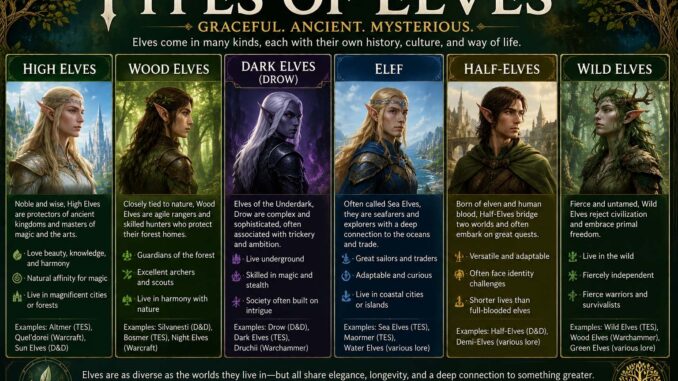
The types of elves in fantasy stories, mythology, tabletop role-playing games, and video games vary in appearance, abilities, culture, and behavior. Some elves live in enchanted forests, while others inhabit underground kingdoms, ancient cities, or magical realms. Although many fictional elves share common traits, each fantasy world gives them unique traditions and characteristics.
Understanding the different types of elves helps readers compare their origins, abilities, and roles across fictional settings. Moreover, this knowledge can help gamers choose characters that match their interests and preferred playstyles.
What Makes the Types of Elves Different?
Elves appear in many fictional settings, so their characteristics depend on the world in which they exist. In traditional folklore, elf-like beings may have supernatural qualities or connections to nature. However, modern fantasy often presents elves as long-lived humanoids with distinctive cultures and magical abilities.
For example, some elves protect forests and ancient knowledge. Others focus on spellcasting, combat, craftsmanship, or political power. Consequently, their environments and traditions often influence their skills and relationships with other peoples.
There is no universal classification covering all types of elves. Instead, authors and game developers create different groups to support their own stories and fictional worlds.
Main Types of Elves and Their Characteristics
Several popular elf groups appear throughout fantasy literature and gaming. Their names may be familiar, although their exact traits can change between fictional universes.
High Elves: Magical and Scholarly Traditions
High elves are frequently portrayed as sophisticated, educated, and connected to magical traditions. They may live in elegant cities, ancient fortresses, or secluded kingdoms. In addition, their societies often value history, literature, art, and advanced spellcasting.
Some stories present high elves as guardians of ancient knowledge. However, others portray them as proud or politically divided, creating conflicts between tradition and change.
In role-playing games, high elves may suit characters who focus on intelligence, magic, diplomacy, or a combination of these strengths.
Wood Elves: Forest Skills and Nature
Wood elves are commonly associated with forests, wildlife, and wilderness survival. They may build hidden settlements among trees or protect sacred woodland areas from outside threats.
Their fictional abilities often include stealth, archery, tracking, and moving through natural environments. As a result, they frequently appear as scouts, rangers, hunters, and forest guardians.
Nevertheless, not every wood elf community avoids outsiders. Some stories portray them as traders, diplomats, and allies who cooperate with other peoples to protect their lands.
Dark Elves and Drow: Underground Societies
Dark elves are a broad fantasy concept, while drow are a specific elf people in certain role-playing settings. These terms are not always interchangeable because different authors use them in different ways.
In Dungeons & Dragons, drow are associated with underground societies, distinctive magical traditions, and complicated social structures. Some stories emphasize secrecy and political rivalry, while others explore individuals who reject their society’s expectations.
An individual’s appearance or background does not determine their personality. Instead, personal choices, relationships, and experiences help define each character.
Sea Elves: Aquatic Abilities
Sea elves appear in some fantasy worlds as elves adapted to underwater life. Depending on the setting, they may swim efficiently, communicate with marine creatures, or possess other aquatic traits.
Their communities may include underwater settlements, coastal kingdoms, or groups that protect ocean environments. Furthermore, their traditions can revolve around navigation, marine wildlife, and the relationship between land and sea.
Sea elves work particularly well in stories involving underwater exploration, oceanic mysteries, and adventures beyond ordinary settlements.
Moon Elves: Celestial Themes
Moon elves appear in certain fantasy settings that connect elf identities with celestial themes. They may be associated with moonlight, artistic expression, magical traditions, or a willingness to explore distant places.
However, moon elves do not have one universally accepted set of traits. Their appearance, abilities, and cultural traditions depend on the fictional world.
Sun Elves: Ancient Knowledge and Tradition
Sun elves are sometimes associated with sunlight, ancient knowledge, nobility, or powerful magical traditions. Some fictional worlds portray them as disciplined and proud, while others give them varied personalities and social structures.
Their name does not always mean they can control sunlight. Instead, it may represent a cultural identity, symbolic tradition, or connection with a particular magical system.
Snow Elves and Ice Elves: Cold Environments
Snow elves and ice elves are less standardized than high elves or wood elves. They commonly appear in fantasy worlds featuring frozen kingdoms, magical winters, or isolated mountain settlements.
Writers may give them resistance to cold, frost-inspired appearances, ice magic, or strong survival skills. However, these characteristics are creative choices rather than universal rules.
Types of Elves in Dungeons & Dragons
Dungeons & Dragons provides a specific rules-based approach to elves. Available traits and character options vary between editions and published books. Therefore, players should check the rules that apply to their particular campaign.
The official D&D Beyond rules for races offer a starting point for understanding elf options in the 2014 Basic Rules.
High Elf Character Options
High elves can suit players who want characters connected to magical learning and traditional elven culture. Depending on the applicable rules, their features may support a combination of weapon use and spellcasting.
For example, a high elf wizard might focus on arcane knowledge, while another character could combine magic with exploration or combat.
Wood Elf Character Options
Wood elves often suit characters who explore wilderness areas. Their traditional themes fit rangers, scouts, and adventurers who rely on awareness and mobility.
Even so, a character’s class and background should guide the final build. Choosing an elf option does not restrict a player to one particular role.
Drow Character Options
Drow can support characters with connections to underground cultures, distinctive traditions, and complex personal histories. A player might portray a character who follows their community’s customs or chooses a different path.
Before selecting this option, review the features and limitations in your campaign’s rules. Different editions and supplementary books may present elf options differently.
How to Choose Between Different Types of Elves
The best elf choice depends on your preferred playstyle, the campaign setting, and the story you want to tell. Instead of choosing a character based only on appearance, consider how its abilities and background fit your goals.
- Prefer magic? Consider a high elf or another magic-oriented option available in your game.
- Enjoy wilderness exploration? A wood elf may fit your character concept.
- Interested in underground settings? A drow or another subterranean elf may be appropriate.
- Want an aquatic adventure? Explore sea elf options if your game includes them.
- Creating a fantasy world? Develop original traditions, strengths, and weaknesses that suit your story.
Additionally, think about your character’s personality, relationships, and motivations. These details often make a character more memorable than abilities alone.
Players who enjoy tabletop gaming may also find useful information in this types of dice guide.
Types of Elves in Mythology and Folklore
Elves in mythology and folklore are not identical to those commonly found in modern fantasy games. Historical traditions vary by region and period, and translations sometimes group different supernatural beings under the same English term.
In some Northern European traditions, elf-like beings are connected with supernatural forces, beauty, mystery, or the natural world. Their descriptions and roles vary across surviving stories and later interpretations.
Modern fantasy authors have adapted these ideas in many ways. Some emphasize long life and magical abilities, while others focus on hidden realms, relationships with nature, or interactions with human communities.
Consequently, the elf groups described in video games should not be treated as a universal representation of historical beliefs. It is helpful to distinguish traditional folklore from modern fictional inventions.
Types of Elves in Popular Fantasy Games
Video games adapt familiar elf concepts to support gameplay, storytelling, and world-building. As a result, the same elf label may have different meanings across franchises.
Elves in Role-Playing Games
Role-playing games often use elf identities to shape character creation. A particular group might offer specific abilities, cultural backgrounds, dialogue options, or story connections.
However, the exact mechanics depend on the game. Players should review in-game descriptions before assuming that an elf type provides a particular bonus or ability.
Elves in Action and Adventure Games
In action and adventure games, elves may appear as archers, spellcasters, warriors, ancient rulers, or mysterious allies. Their designs can communicate speed, elegance, magical power, or a connection with nature.
Some games also use elven ruins and artifacts to reveal the history of their fictional worlds. For more gaming-related reading, explore this secret of the ring ruins guide.
Elves in Fantasy-Inspired Builds
Some players create characters inspired by legendary warriors or distinctive fantasy personalities. These builds often combine appearance, equipment, and fighting style rather than copying one particular elf tradition.
Players who enjoy unusual combat concepts can also explore the let me solo her build guide for inspiration when designing their own character.
Remember that game mechanics and fictional lore do not always follow the same rules. Therefore, use official descriptions when accuracy matters and treat fan-created interpretations as creative alternatives.
Choosing the Right Elf for Your Fantasy Story
When deciding which elf best fits a character or story, start with the role that character needs to play. A forest guardian, an underground diplomat, and an ocean explorer will naturally have different experiences and priorities.
Next, consider the world itself. Think about the environment, political relationships, traditions, and magical rules that shape elven society. These details help explain why one community differs from another.
Finally, avoid relying only on familiar stereotypes. A high elf can be adventurous rather than proud, and a wood elf can be curious about city life rather than withdrawn. Giving characters individual goals and weaknesses creates more believable stories.
Frequently Asked Questions About Types of Elves
What Are the Main Types of Elves?
Common fantasy examples include high elves, wood elves, dark elves or drow, sea elves, moon elves, and sun elves. However, each fictional universe defines its own categories, so this list is not universal.
Are High Elves and Wood Elves Different?
Yes, in many fantasy settings. High elves are often associated with magic, scholarship, or ancient traditions, while wood elves are commonly connected with forests and wilderness skills. Their precise traits depend on the world or game.
Are Dark Elves and Drow the Same?
Not always. Drow are a specific elf people in Dungeons & Dragons, whereas dark elf is a broader term used differently across fantasy works. Always check the lore of the particular setting.
Do All Elves Have Magical Powers?
No. Magic is common in fantasy depictions of elves, but its role varies. Some elves possess innate magical abilities, while others rely on practical skills, training, technology, or ordinary weapons.
Which Elf Type Is Best for a Role-Playing Game?
There is no single best option. Choose according to the game’s rules, your preferred abilities, the campaign setting, and the personality you want to develop.
Are Fantasy Elves Based on Mythology?
Many modern portrayals draw inspiration from European folklore and later literary traditions. Nevertheless, contemporary fantasy has introduced many original characteristics that do not necessarily appear in historical sources.
Final Thoughts on the Types of Elves
The types of elves in fantasy offer a wide range of cultures, environments, abilities, and character possibilities. From forest-dwelling guardians to scholarly spellcasters and aquatic communities, each interpretation can contribute something different to a fictional world.
Ultimately, understanding these differences helps readers appreciate fantasy lore and helps players choose characters that suit their preferred adventures. By checking the rules of a particular game and looking beyond familiar stereotypes, you can discover new ways to enjoy elven characters in stories, tabletop campaigns, and video games.