
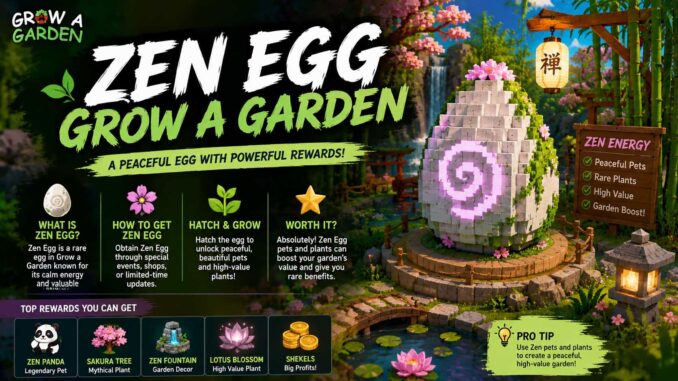
The Zen Egg Grow a Garden players remember from the Zen Update is one of the game’s themed pet eggs, offering a chance to hatch pets such as Shiba Inu, Nihonzaru, Tanuki, Tanchozuru, Kappa, and the extremely rare Kitsune. The egg arrived with the Zen Update on July 19, 2025, alongside Tranquil crops, Chi, the Zen Channeller, new plants, cosmetics, and the Zen Aura event.
For collectors, the biggest attraction has always been the pet pool. Meanwhile, progression-focused players value certain Zen pets because their abilities can interact with farming and mutations.
However, Grow a Garden has received many updates since the Zen event launched. Therefore, current availability, shop rotations, trading values, and balance details can change. Always check the live game before spending limited resources.
What Is the Zen Egg Grow a Garden?
The Zen Egg is a themed pet egg introduced as part of Grow a Garden’s Zen content. According to the game’s community documentation, it was classified as a Legendary egg and originally tied closely to the Zen progression system.
The wider Zen Update revolved around collecting Tranquil-mutated crops and contributing them to the Zen Channeller. During the original event structure, the Zen Aura appeared at the beginning of each hour, giving plants opportunities to receive the Tranquil mutation. Players could then use those crops to progress the central Zen tree and access rewards.
That made the Grow a Garden Zen Egg more than a random collectible. It became part of a larger farming loop:
Grow crops → obtain Tranquil mutations → progress Zen systems → collect rewards → hatch Zen pets → improve future farming options.
Players familiar with other themed eggs will recognize the basic idea. For example, the bee egg grow a garden system also centers on obtaining themed pets whose value comes from both collection and gameplay utility.
Grow a Garden Zen Egg Pets List
Six pets were associated with the Zen Egg hatch pool during its original release. Community references and contemporary guides identify the following lineup.
| Zen Egg Pet | Original Hatch Chance |
|---|---|
| Shiba Inu | 40% |
| Nihonzaru | 31% |
| Tanuki | 20.82% |
| Tanchozuru | 4.6% |
| Kappa | 3.5% |
| Kitsune | 0.08% |
These published probabilities total 100% and show just how heavily the egg favored common pets compared with Kitsune.
Because game data can be rebalanced, treat these as the original Zen Egg odds rather than a guarantee that every later version or reappearance uses exactly the same numbers.
Shiba Inu
Shiba Inu was the most common Zen Egg hatch at a reported 40%.
That high probability makes it the pet players were most likely to encounter while opening several eggs. Although common pets may not have the same prestige as a Kitsune or Kappa, they can still be useful early in an event or for players building their collection.
The important beginner lesson is simple: do not assume every Zen Egg will deliver a rare pet.
With a 40% historical chance for Shiba Inu alone, duplicates were always part of the expected grind.
Nihonzaru
Nihonzaru had a reported 31% hatch chance, making it another frequent result.
Because Shiba Inu and Nihonzaru together accounted for a large portion of the original hatch pool, players opening only a few eggs could easily see mostly these two pets.
That does not necessarily mean the egg is bugged or your account has unusually bad luck. Random hatch systems naturally produce streaks.
Tanuki
Tanuki sat in the middle of the pool at roughly 20.82%.
At that probability, it was noticeably less common than Shiba Inu or Nihonzaru, yet still far easier to hatch than the highest-rarity options.
This middle tier can matter for collectors because it creates a natural progression between basic hatches and the more exciting rare pets.
Best Rare Pets to Get From the Zen Egg in Grow a Garden
The most sought-after Zen pets generally came from the lower end of the probability table.
Tanchozuru
Tanchozuru had an original hatch chance of about 4.6%.
It became especially interesting because contemporary coverage described its passive ability as periodically affecting nearby fruits with Tranquil-related effects, making it relevant to players who wanted to continue generating useful mutations.
That creates a different kind of value from pure rarity.
A pet does not have to be the rarest hatch to be strategically important. If its passive supports your farming loop, it can sometimes provide more practical value than a trophy pet that contributes little to production.
Kappa
Kappa was even rarer, with a reported 3.5% hatch chance.
For collectors, reaching this rarity tier makes every egg significantly more exciting. However, a 3.5% chance still means there is no predictable number of eggs that guarantees a Kappa.
One player might hatch one quickly, while another could open dozens without seeing it.
That is simply how independent random rolls work.
Kitsune
Kitsune was the headline pet of the Zen Egg.
Its original reported probability was only 0.08%, making it dramatically rarer than every other pet in the pool. Contemporary coverage specifically highlighted Kitsune as one of the major rewards players were chasing from the Zen content.
A 0.08% chance is roughly 1 in 1,250 on average, but that does not mean every 1,250 eggs guarantees one Kitsune.
Each hatch is a random event.
You could get lucky far earlier, or you could open more than the statistical average without receiving one.
How Players Originally Got Zen Eggs
During the Zen event, progression centered on Tranquil crops and the Zen Channeller.
The Zen Aura event appeared at the start of every hour, and affected plants could receive the Tranquil mutation. Players then donated qualifying produce toward the central Zen tree, unlocking more rewards and Zen Shop progression.
Contemporary player guides also documented Zen Eggs as obtainable through Zen-related rewards and shop systems, with community documentation listing the egg as purchasable for Chi through the Zen Shop during its active setup.
Because Grow a Garden’s content and availability systems can change over time, players returning after later updates should verify whether the Zen Egg is currently obtainable directly, only through legacy inventories, trading, returning content, or another in-game method.
Avoid assuming that an old 2025 farming guide still reflects the live 2026 interface.
Zen Egg vs Other Grow a Garden Eggs
Grow a Garden has used themed eggs repeatedly to introduce groups of pets.
The main difference between these eggs is usually their pet pool, rarity distribution, event connection, and the usefulness of their passives.
For example, players researching the primal egg grow a garden may be looking for pets tied to an entirely different update theme and farming strategy.
Likewise, the mythical egg grow a garden belongs to another part of the game’s pet ecosystem, so its hatch expectations should not be mixed with Zen Egg odds.
The best egg is therefore not simply the one with the rarest-looking pet.
Instead, ask what you actually need:
- Collection completion
- Farming support
- Mutation utility
- Trading demand
- A specific pet ability
- A rare showcase pet
- Better overall pet slots
That makes egg decisions much easier.
Should You Hatch or Save Zen Eggs?
If you already own Zen Eggs, deciding whether to hatch them immediately depends on your goals.
Hatch Them if You Need the Pets
Newer players may benefit from opening eggs because even common pets can fill empty slots and provide useful abilities.
Likewise, collectors hunting a missing Zen pet have little reason to keep every egg unopened unless the egg itself has collectible or trade value.
Save Them if You Care About Trading
Legacy or unavailable items can sometimes become desirable when newer players can no longer obtain them through normal gameplay.
However, trading markets can change quickly. Therefore, never assume an unopened Zen Egg will automatically become more valuable.
Check current in-game trading conditions before making a decision.
Don’t Hatch Only Because You Expect Kitsune
The 0.08% historical Kitsune rate makes this a high-variance chase.
If Kitsune is the only pet you’re after, don’t assume that opening more eggs will guarantee getting one.
That makes resource planning especially important for players who would otherwise sacrifice useful trade assets simply for a tiny random chance.
Zen Egg Pets: Grow a Garden Strategy for Beginners
Beginners often focus entirely on rarity.
A better approach is to evaluate what each pet actually does for your garden.
First, fill your active pet slots with creatures that support your current farming strategy.
Next, keep rare pets even when their immediate use seems limited because they may become relevant to future builds, collection goals, or trades.
Then compare new Zen pets against your existing roster rather than automatically replacing older pets.
The grow a garden pets tier list can be useful for broad comparisons, but tier rankings should never replace reading the actual passive. A lower-ranked pet may work perfectly with your particular plants or mutation strategy.
Finally, remember that pet value can change when game mechanics are adjusted.
Comparing Zen Egg With Dinosaur-Themed Eggs
The Zen Update followed a prehistoric-themed period of Grow a Garden, and contemporary coverage specifically described the game moving away from dinosaurs toward the calmer Zen theme in July 2025.
That transition makes the dinosaur egg grow a garden a useful comparison.
Dinosaur pets and Zen pets were designed around different themes and farming mechanics. Therefore, choosing between them should depend on the passive abilities you need rather than which update came later.
Experienced players usually gain more value by creating a complementary pet lineup instead of filling every slot with pets from a single egg family.
How RNG Works With Zen Egg Hatches
Random hatching is one of the easiest systems to misunderstand.
Suppose Kitsune has a 0.08% chance.
Opening one egg does not increase the chance on the next egg unless the game explicitly uses a pity mechanic. Likewise, failing 100 times does not make the next hatch automatically lucky.
For common pets, repeated duplicates are expected.
For rare pets, long unlucky streaks are also mathematically possible.
Therefore, avoid setting an exact number of eggs and telling yourself, “I must get Kitsune by then.”
Probability describes long-run behavior across many rolls. It does not promise a specific result to one player.
Common Zen Egg Mistakes
Spending Everything for One Rare Pet
Chasing Kitsune can consume a large amount of time or trade value.
Before committing, decide whether you genuinely want the pet or simply want it because it is rare.
Ignoring Useful Mid-Tier Pets
A Tanchozuru may provide practical farming utility even though Kitsune attracts more attention.
Gameplay value and rarity are not always the same thing.
Trusting Old Trading Prices
Trading values move as supply and demand change.
A value posted during the original Zen Update may have little connection to a later market.
Assuming Every Guide Uses Current Data
Grow a Garden changes frequently.
A guide published around July 2025 may accurately describe the original Zen event while being outdated for a later version of the game.
Always separate historical hatch data from current availability and trade value.
Zen Egg Grow a Garden FAQs
What pets can hatch from the Zen Egg?
The original Zen Egg pool contained Shiba Inu, Nihonzaru, Tanuki, Tanchozuru, Kappa, and Kitsune.
What is the rarest Zen Egg pet?
Kitsune was the rarest original hatch, with a reported 0.08% probability.
How rare is Kappa?
Kappa’s original published hatch probability was approximately 3.5%.
How rare is Tanchozuru?
Tanchozuru’s original hatch probability was approximately 4.6%.
When was the Zen Update released?
The Zen Update launched on July 19, 2025. It introduced the Zen event, Tranquil-related mechanics, new pets, plants, rewards, and cosmetics.
Is Kitsune guaranteed after opening enough Zen Eggs?
No fixed number of standard random rolls guarantees a Kitsune unless the game provides a separate guarantee or pity mechanic. The original reported hatch chance was 0.08%, so unlucky streaks can be very long.
Are Zen Egg odds still the same?
The figures in this guide describe the documented original Zen Egg pool. Because Grow a Garden can receive updates and balance changes, verify the current in-game information before making decisions based on older probabilities.
Getting the Most Value From Your Zen Eggs
The Zen Egg Grow a Garden system is easiest to understand when you separate three things: rarity, utility, and current market value.
Shiba Inu and Nihonzaru dominated the original hatch pool, while Tanchozuru and Kappa offered much rarer outcomes. Kitsune sat at the extreme end with its reported 0.08% chance, making it the headline chase pet of the Zen Update.
Still, the rarest hatch is not automatically the best pet for every garden.
Check each passive, compare it with your existing lineup, and decide whether hatching or saving an egg supports your actual goal. Most of all, use current in-game information for availability and trading decisions while treating the original Zen probabilities as historical reference data.