
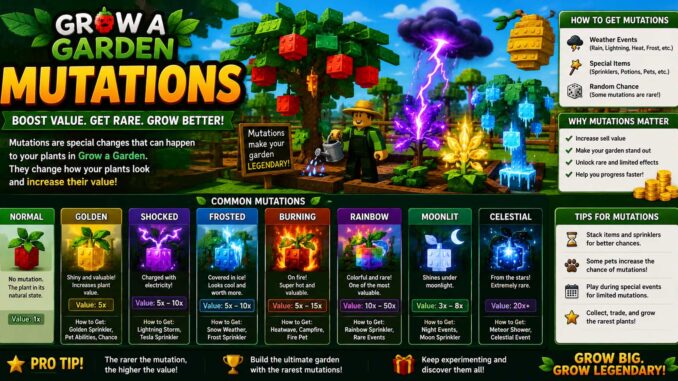
If you have ever harvested a normal-looking crop only to see another fruit glowing, frozen, golden, or covered in a special effect, you have already seen why Grow a Garden mutations matter. In Roblox’s Grow a Garden, mutations can change the appearance and, more significantly, the value of crops. Pet mutations form a separate system that can alter a pet’s abilities and usefulness.
The basic idea sounds simple: grow crops, get mutations, and sell valuable produce. However, the system becomes more strategic once weather, events, pets, growth variants, mutation compatibility, and stacking enter the picture.
Because Grow a Garden continues to receive updates, exact mutation availability and mechanics can change. Therefore, players should treat older mutation lists cautiously, especially when an event-exclusive mutation is involved.
What Are Grow a Garden Mutations?
Mutations are special properties that can appear on crops under particular conditions. Some occur because of weather, while others may depend on events, pets, tools, or other gameplay mechanics.
A mutated crop can become much more valuable than its ordinary version. However, not every mutation works the same way, and certain mutations cannot coexist.
Growth variants are especially significant. For example, community documentation lists Golden and Rainbow as major growth variants, with Golden carrying a ×20 multiplier and Rainbow ×50. Environmental mutations then interact with the crop’s value calculation rather than simply behaving like a single flat multiplier in every situation.
Therefore, simply collecting the largest possible number of effects is not always the smartest strategy. Players should consider the base crop, its weight, growth variant, compatible mutations, and how much time or effort the setup requires.
That also makes crop selection relevant. If you are deciding what deserves garden space before chasing rare effects, comparing the best plants in grow a garden can help you start with crops that better fit your farming goals.
How Mutations Grow a Garden Crop Value
One of the biggest beginner mistakes is assuming every listed multiplier simply multiplies the previous one.
The actual value system is more nuanced. Community-maintained references describe crop value as being influenced by factors such as crop mass, base mass, base price, growth mutation, environmental mutations, and friend boosts. Growth variants such as Golden or Rainbow are handled separately from environmental mutation bonuses.
In practical terms, this means a high-value base crop with a strong growth variant and several compatible environmental mutations can become extremely valuable.
Growth mutations
Golden and Rainbow are two of the easiest growth variants for new players to understand conceptually.
Golden offers a major improvement over an ordinary crop, while Rainbow provides an even stronger growth multiplier according to current community documentation. However, a crop cannot simply be both Golden and Rainbow at the same time.
Because Rainbow interacts strongly with other mutations, getting it on a valuable crop can form the foundation of a high-value setup.
Environmental mutations
Environmental mutations can come from conditions such as weather or special events.
For example, Wet has historically been associated with rain or thunderstorms, while Chilled relates to cold conditions. Frozen is another cold-related effect, although compatibility restrictions mean Wet, Chilled, and Frozen cannot simply be stacked together freely.
Other mutations have appeared through special events and mechanics.
All Mutations in Grow a Garden: Why Lists Keep Changing
Players searching for all mutations in Grow a Garden should know that a permanent list can become outdated quickly.
Grow a Garden regularly introduces event mechanics, pets, weather conditions, and other systems capable of applying new effects. Some mutations can also become unavailable when the event or method connected to them ends.
For example, Amber arrived with the Prehistoric Update and could be applied through specific mechanics connected to that update. Meanwhile, the Corruption Update introduced Corrupt-related gameplay and new ways for fruits to receive themed effects.
As a result, it is more useful to understand mutation categories than to memorize one static list.
A simple way to think about them is:
| Mutation Category | Typical Source | Main Reason to Chase It |
|---|---|---|
| Growth variants | Crop growth mechanics | Strong value foundation |
| Weather mutations | Rain, frost, special weather | Increase crop value |
| Event mutations | Limited or special events | Rare effects and value |
| Pet-applied mutations | Pet abilities | More control over mutation farming |
| Special mechanics | Tools or update features | Target specific effects |
| Pet mutations | Mutation Machine and related methods | Improve or change pets |
Since mutations affect the economic side of the game, players who also trade should compare current grow a garden trade values rather than assuming a rare-looking item automatically has a fixed market value.
Best Mutations in Grow a Garden
There is no single answer to the best mutations in Grow a Garden because “best” can mean several things.
For a crop seller, the best mutation may be the one that contributes the most to final sale value. For a collector, rarity or appearance may matter more. Meanwhile, an advanced farmer may prefer effects that can be applied reliably across many high-value crops.
Rainbow is particularly attractive because its growth multiplier can combine with compatible environmental effects. Meanwhile, mutations such as Shocked have historically offered very large environmental bonuses compared with common effects such as Wet.
Still, chasing a rare mutation on a poor target can waste time.
Instead, start with a crop worth investing in. Then improve the growth variant and look for compatible environmental effects. Finally, decide whether holding the crop for another event is worth the opportunity cost.
This approach is generally better than mutating every available fruit without a plan.
How to Get More Grow a Garden Mutations
Although luck remains part of the game, players can improve their opportunities.
Keep valuable crops available
Harvesting everything immediately can work against mutation farming. If an important weather event starts and your garden has few worthwhile fruits available, you may miss a chance to mutate something valuable.
Instead, keep suitable targets growing when you expect useful weather or event conditions.
Pay attention to weather
Weather is central to several mutation mechanics. Therefore, watch the environment rather than farming on autopilot.
Rain, thunderstorms, cold conditions, and special event weather can create different opportunities.
Use mutation-applying pets strategically
Some pets can apply mutations through their abilities. As a result, pets can make mutation farming more controlled than relying only on random environmental conditions.
However, pets vary widely in usefulness. Before investing heavily in one, a grow a garden pets tier list can help you compare pets based on the role you actually need, rather than rarity alone.
Don’t harvest a valuable target too early
A strong crop can become even more valuable if another compatible mutation is added later.
Therefore, advanced players often treat certain fruits as projects. They preserve them while waiting for worthwhile mutation opportunities instead of selling immediately after the first useful effect appears.
However, this strategy has a tradeoff: a crop sitting in your garden is not producing spendable Sheckles.
Pet Mutations Grow a Garden Players Should Understand
Pet mutations Grow a Garden gameplay into a different system from crop mutation farming.
Current community documentation says the Mutation Machine is located near the Egg Shop and can mutate eligible pets, although requirements and options have evolved as the game has been updated.
This distinction matters because crop mutations generally focus heavily on produce and value, while pet mutations can alter the pet itself.
Documented pet mutations include effects that can improve XP gain or allow pets to apply particular mutations to nearby fruit. For example, Shiny provides an XP-related bonus, while certain other pet mutations can help apply crop effects.
Also, pet mutations do not simply stack endlessly. Community documentation states that putting an already mutated pet through the Mutation Machine again replaces its existing mutation rather than adding another one.
Therefore, rerolling a useful pet deserves some thought.
Mutation Value vs Trading Value
A crop’s calculated selling value and its desirability to another player are not necessarily identical concepts.
A highly mutated crop can have an impressive in-game value, yet player-to-player demand can depend on rarity, availability, collecting trends, current events, and what traders actually want.
Likewise, pets can command very different levels of interest depending on abilities and current strategies.
For that reason, a current grow a garden value list can provide useful context before you make a trade. Still, treat community values as guides rather than guaranteed prices because player markets can move quickly.
This distinction becomes especially useful when deciding whether to sell an item, keep it, or use it as part of a trade.
Advanced Mutation Strategy
Once you understand the basics, stop thinking about mutation farming as simply “get as many as possible.”
Instead, think about efficiency.
First, identify a crop that deserves investment. Next, preserve good specimens instead of automatically harvesting them. Then use weather, pets, and event opportunities to improve them over time.
Also, learn compatibility restrictions. For example, Golden and Rainbow cannot occupy the same growth slot, while Wet, Chilled, and Frozen have restrictions on how they coexist.
Finally, separate your farming goals from your trading goals. A crop you want to build into a mutation showcase may need a different strategy from items you plan to move through the trading market.
If seeds enter your trading plan, understanding can you trade seeds in grow a garden is also useful before you organize inventory around a deal.
Common Mutation Mistakes
While instant Sheckles feel useful, waiting for another compatible mutation can sometimes create a much stronger result.
Another mistake is treating every mutation multiplier as if it stacks independently. Since the value formula handles growth and environmental effects differently, the final result may not match a simple multiplication of every displayed number.
Players also sometimes spend too much effort mutating low-priority crops. A flashy mutation does not automatically turn every fruit into an ideal long-term target.
Finally, don’t assume an old mutation guide represents the current game. Event content and available methods change, so check current in-game information before spending rare resources.
Grow a Garden Mutations FAQs
Can a crop have multiple mutations?
Yes, compatible environmental mutations can appear together. However, restrictions apply to certain groups, so not every effect can coexist on one crop.
Can Golden and Rainbow stack?
No. Current community documentation treats Golden and Rainbow as mutually exclusive growth variants.
Are crop mutations and pet mutations the same?
No. Crop mutations affect produce, including its value and appearance, while pet mutations affect pets and can provide different passive effects or abilities.
Do pet mutations stack?
Not through repeatedly rerolling the same pet in the Mutation Machine. A new mutation replaces the existing one rather than stacking with it.
Is the rarest mutation always the best?
Not necessarily. Rarity matters to collectors, but farming efficiency depends on the mutation’s effect, the crop receiving it, compatibility with existing mutations, and how much effort it takes to obtain.
Build Your Garden Around Mutation Opportunities
The smartest way to approach Grow a Garden mutations is to combine patience with planning. Start with crops worth keeping, understand which mutation categories can work together, pay attention to weather and events, and use pets when their abilities support your farming strategy.
At the same time, avoid chasing every rare effect simply because it exists. Grow a Garden changes frequently, so the strongest strategy is flexible: protect valuable targets, recognize good mutation opportunities, and adjust when new events or mechanics arrive.
Once you understand that system, mutations stop feeling like random visual bonuses and become another part of planning a productive, valuable garden.