
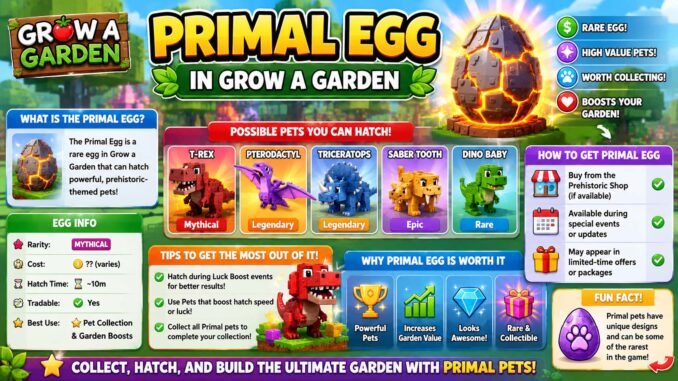
The primal egg grow a garden players collected during the Prehistoric update is an interesting item for collectors who enjoy dinosaur-themed pets. This limited egg contains six prehistoric companions, each with a different hatch chance and special ability. Therefore, understanding its pets can help you decide whether to hatch, keep, or trade an egg.
However, owning a Primal Egg and obtaining a new one are two different things. Availability can change with game updates, so check the current game before spending valuable currency or trading your pets.
Whether you’re a beginner or an experienced player, learning about the egg’s hatch chances, abilities, and trading considerations can help you build a collection that suits your goals.
Watch this short video for additional inspiration:
What Is the Primal Egg in Grow a Garden?
The Primal Egg is a limited egg introduced during the Prehistoric update in Grow a Garden, a Roblox gardening game. It contains six dinosaur-themed pets, ranging from common companions to the extremely rare Spinosaurus.
Unlike eggs focused on other pet families, the Primal Egg features prehistoric companions with different passive abilities. For example, some help with cosmetic crates or crafting, while others provide benefits related to dinosaur pets or fruit mutations.
The standard Primal Egg has a hatch timer of approximately four hours and ten minutes. However, premium versions may have different timers or reward pools.
Because limited items can become unavailable, don’t assume the Primal Egg is still obtainable through the regular Egg Shop. Instead, check current in-game announcements and available acquisition methods.
You can also visit the official Grow a Garden game on Roblox to access the experience and review available in-game options.
Why Primal Egg Grow a Garden Pets Are Popular
The main attraction of Primal Egg pets is their combination of collectible designs and specialized abilities. Although some companions are rarer than others, the best choice depends on how you play.
Players may want these pets for several reasons:
- Collection goals: Complete a dinosaur-themed pet collection.
- Crafting support: Use abilities that may duplicate crafted items.
- Fruit mutations: Explore the Spinosaurus mutation-related ability.
- Pet progression: Benefit from Iguanodon’s dinosaur experience bonus.
- Trading opportunities: Exchange limited pets when another player wants a particular companion.
Nevertheless, rarity alone does not determine a pet’s usefulness or trading value. A common companion may be more practical for your current activities, while a rare pet may attract collectors.
How to Get the Primal Egg in Grow a Garden
The original Primal Egg was connected to the Prehistoric update and its special event and crafting mechanics. However, its current availability may differ from its original acquisition methods.
Check Primal Egg Grow a Garden Availability
First, check the live game and any active events. Limited eggs may disappear from normal acquisition methods after an event ends.
Review the available shops, crafting options, and event information before collecting materials. This step helps you avoid following an outdated method that no longer works.
Review Primal Egg Grow a Garden Crafting Requirements
The original crafting system involved the game’s DNA Machine and progression requirements. However, recipes and access conditions can change over time.
Therefore, verify the current recipe before spending resources. Don’t rely on an older guide without checking whether the method is still available.
Consider Trading With Other Players
If the Primal Egg is unavailable through regular gameplay, trading may be an option when the current game system permits it.
Before accepting an offer, compare several trades and review recent market activity. You can also consult this guide to grow a garden trade values to help evaluate an offer.
Remember that community trading estimates can change quickly. Use them as guidance rather than guaranteed prices.
Primal Egg Grow a Garden Pets and Hatch Chances
The standard Primal Egg has six possible pets, and each one has a different hatch probability. Consequently, some companions are much more common than others.
| Pet | Hatch chance | Main ability |
|---|---|---|
| Parasaurolophus | 35% | Reduces the remaining opening time of a cosmetic crate |
| Iguanodon | 32.5% | Grants bonus experience to active dinosaur pets |
| Pachycephalosaurus | 28% | Has a chance to duplicate a crafted item |
| Dilophosaurus | 3% | Can advance other pets’ cooldowns or grant bonus experience |
| Ankylosaurus | 1% | Can help return a fruit when another player steals one |
| Spinosaurus | 0.5% | Transfers a mutation from one fruit to another |
These probabilities total 100% for the standard egg. However, each hatch is random, so no particular result is guaranteed.
For example, Spinosaurus has a 0.5% hatch chance, which is roughly one in 200 eggs on average across many independent attempts. This does not mean that opening 200 eggs guarantees a Spinosaurus.
Before spending resources, consider which abilities match your goals. A crafting-focused player may prefer Pachycephalosaurus, while someone interested in fruit mutations may prefer Spinosaurus.
Are Primal Egg Grow a Garden Pets Worth Keeping?
Primal Egg pets can be worthwhile if their abilities support your preferred playstyle or if you enjoy collecting rare companions. However, their usefulness depends on your activities and priorities.
For instance, Pachycephalosaurus may appeal to players who regularly craft items. Meanwhile, Iguanodon may help players who actively develop a team of dinosaur pets.
Spinosaurus attracts attention because of its low hatch chance and mutation-related ability. Even so, its rarity does not automatically make it the best companion for every garden.
To compare pets from different eggs, review this grow a garden pets tier list. Use rankings as a starting point, then consider your own goals and current game mechanics.
Beginner Tips for Opening a Primal Egg
Opening a limited egg can be exciting. However, preparing beforehand can help you avoid unnecessary spending and make better choices.
Save Your Valuable Currency
Don’t spend all your currency on one limited item without considering your other needs. You may need resources for seeds, equipment, crafting, or different pets.
If the egg is unavailable, avoid rushing into an expensive trade simply because you want to complete your collection.
Check Current Events and Updates
Game updates can change item availability, pet abilities, and crafting requirements. Therefore, review current information before deciding whether to open, trade, or hold an egg.
An event does not automatically improve hatch chances. Only assume that probabilities have changed when the game explicitly indicates a different reward pool or rate.
Organize Your Pet Inventory
Before hatching an egg, review your existing pets and decide which companions you want to keep. This makes it easier to compare new pets with your current team.
Also, consider your available pet slots and whether you need to reorganize your lineup.
Understand Primal Egg Grow a Garden Hatch Chances
Parasaurolophus, Iguanodon, and Pachycephalosaurus have the highest listed hatch chances in the standard Primal Egg. In contrast, Dilophosaurus, Ankylosaurus, and Spinosaurus are less likely to hatch.
Consequently, don’t spend more than you can afford to lose while chasing a rare companion. Even multiple attempts cannot guarantee a specific pet.
Comparing the Primal Egg With Other Eggs
Different eggs offer different companions and gameplay benefits. The right choice depends on your priorities, available resources, and which eggs you can currently obtain.
| Egg or pet family | Main focus | Who may prefer it |
|---|---|---|
| Starter eggs | Basic companions | New players |
| Bee Egg | Bee-themed pets and pollination-related gameplay | Players interested in bee companions |
| Dinosaur Egg | Dinosaur-themed pets | Players building a dinosaur collection |
| Primal Egg | Six prehistoric pets with varied abilities | Collectors and players interested in its unique abilities |
If you want to compare bee-related companions, read this guide to bee egg grow a garden.
The Bee Egg and Primal Egg serve different collection goals, so neither is automatically better. Instead, compare the available pets and their abilities with the activities you enjoy most.
When Should You Open a Primal Egg in Grow a Garden?
There is no universally best time to open a Primal Egg. Unless the developers announce a change, don’t assume a particular day or event increases its standard hatch chances.
Still, timing can affect your overall strategy.
- Before a major update: Check whether the update may change pet availability or trading demand.
- After organizing your inventory: Make room for new companions and decide which pets you want to keep.
- When you understand current market values: Compare the potential value of holding the egg with the possible results of hatching it.
- When you have a clear goal: Decide whether you want a particular ability, a complete collection, or a pet to trade.
Meanwhile, remember that market demand can change quickly. A pet that attracts attention immediately after an update may become less desirable as more players obtain it.
Common Primal Egg Grow a Garden Mistakes to Avoid
Opening Every Egg Immediately
Opening an egg as soon as you receive it can be tempting. However, holding a limited item may be worth considering if you’re still deciding whether you want its pets or would rather trade it.
Compare both options before making your decision. There is no guarantee that its trading value will increase over time.
Ignoring Trading Values
A rare pet is not automatically worth more than every common pet. Demand, availability, usefulness, and current player preferences all affect trading decisions.
Before accepting an offer, compare similar trades and review current grow a garden trading value information.
Expecting a Guaranteed Spinosaurus
Spinosaurus has a 0.5% hatch chance from the standard Primal Egg. Although this makes it the rarest pet in the listed pool, random results can vary considerably.
Therefore, avoid spending valuable resources based on the assumption that a certain number of eggs will guarantee a rare companion.
Following Outdated Guides
Old guides may describe crafting recipes, event rewards, or acquisition methods that no longer work. Check current in-game information before spending resources or trading valuable pets.
Which Primal Egg Pets Should You Keep?
Your priorities should reflect how you play rather than rarity alone.
- Spinosaurus: Consider it if you value its rare status and mutation-related ability.
- Ankylosaurus: Consider it if its fruit-stealing-related ability suits your gameplay.
- Dilophosaurus: Consider it for its cooldown and bonus experience effects.
- Pachycephalosaurus: Consider it if you frequently craft items.
- Iguanodon: Consider it if you use active dinosaur pets.
- Parasaurolophus: Consider it if you want help reducing cosmetic crate opening time.
These are practical starting points, not a universal ranking. Your priorities may change as you unlock new pets, adjust your team, or discover new strategies.
For example, players focused on bee-related progression may prefer to learn about the petal bee grow a garden before deciding whether to invest in another pet family.
Trading Tips for Primal Egg Owners
Limited eggs and rare companions can attract offers, but you should evaluate each trade carefully.
First, compare several offers instead of accepting the first one. Next, check recent trading information and consider whether the items offered are useful to you. Finally, decide whether you would rather keep the pet for its ability or trade it to improve your collection.
Avoid panic trading after a game update. Prices and player demand can change rapidly, so taking time to compare offers may help you make a better decision.
Also, don’t treat community value guides as guaranteed market prices. Actual offers can differ between players and may change as availability shifts.
Advanced Primal Egg Grow a Garden Strategies
Experienced players can make better decisions by connecting pet abilities to their wider garden strategy.
Build a Team Around Your Goals
Rather than selecting pets based only on rarity, consider how their abilities fit your current activities.
For example, a player who crafts frequently may value Pachycephalosaurus, while someone focused on fruit mutations may prefer Spinosaurus. Similarly, Iguanodon may be more useful when you actively rely on dinosaur pets.
Compare Hatching With Trading
Before opening a limited egg, compare its potential rewards with what another player might offer for the unopened item. If you mainly want one particular pet, trading may sometimes be a more direct option, provided the game allows it and the offer is fair.
However, neither strategy guarantees a better result. Your decision should depend on current availability, trading demand, and the resources you can afford to spend.
Review Updates Before Changing Your Plan
Updates may change game mechanics or introduce new items. Consequently, revisit your strategy when the game changes rather than relying indefinitely on older information.
Frequently Asked Questions About the Primal Egg
Is the Primal Egg Still Obtainable?
The Primal Egg is a limited item associated with the Prehistoric update. Its current availability may differ from its original acquisition methods, so check the live game, available crafting options, and active events before assuming you can obtain another one.
How Long Does a Primal Egg Take to Hatch?
The standard Primal Egg has a hatch timer of approximately four hours and ten minutes. Premium versions have used shorter timers, so check the specific egg type before relying on that timing.
What Is the Rarest Pet in the Primal Egg?
Spinosaurus has the lowest listed hatch chance at 0.5%. This makes it the rarest pet in the standard Primal Egg pool, although a low probability does not guarantee that its trading value will always be the highest.
Are Primal Egg Pets Worth Collecting?
They can be worthwhile for players who enjoy dinosaur-themed companions, want particular abilities, or aim to complete a collection. Their usefulness depends on your goals, while their trading value depends on current demand and availability.
Does Opening More Primal Eggs Guarantee a Rare Pet?
No. Each hatch is random, so opening additional eggs does not guarantee a specific companion. More attempts create more opportunities to obtain a rare pet, but the result can still vary.
Make the Most of Your Primal Egg in Grow a Garden
The Primal Egg gives Grow a Garden players access to six prehistoric companions with different abilities and hatch chances. Spinosaurus stands out for its rarity, while the other pets can support crafting, dinosaur progression, cosmetic crates, or other activities.
Before opening or trading an egg, check its current availability, compare the possible rewards, and decide which pets best match your goals. Since limited items and trading demand can change, avoid relying on outdated acquisition methods or assuming that rare always means valuable.
With realistic expectations and a clear strategy, you can make more informed decisions about your collection and get more value from your time in Grow a Garden.