
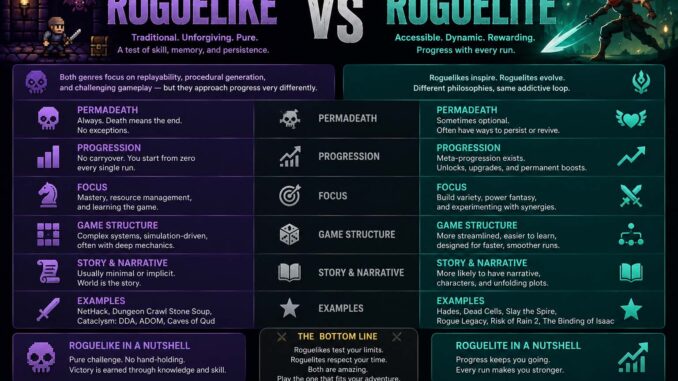
If you’ve searched for roguelike vs roguelite, you’ve probably noticed that players often use the two terms interchangeably. While the genres share many similarities, they are not the same. The biggest distinction is what happens after you fail. In a roguelike, death usually means starting completely from scratch. In a roguelite, you often keep permanent upgrades that make future runs easier.
Understanding this difference helps you choose games that match your preferred level of challenge, whether you enjoy unforgiving dungeon crawls or gradual character progression.
Roguelike vs Roguelite at a Glance
| Feature | Roguelike | Roguelite |
|---|---|---|
| Permadeath | Yes | Yes, but with permanent progression |
| Randomly Generated Levels | Usually | Usually |
| Permanent Upgrades | Rare | Common |
| Difficulty | Very High | Moderate to High |
| Replay Value | Excellent | Excellent |
| Beginner Friendly | Less | More |
Although both genres encourage repeated runs, the overall experience feels very different.
What Is a Roguelike?
A roguelike is inspired by the 1980 game Rogue.
These games typically feature:
- Randomly generated levels
- Turn-based or strategic gameplay
- Permanent death
- Resource management
- Fresh runs every time you play
When your character dies, nearly all progress disappears. Every new run begins with limited equipment and requires players to adapt to new layouts, enemies, and items.
Success depends heavily on learning game mechanics rather than collecting permanent upgrades.
Why Roguelikes Appeal to Experienced Players
Many fans enjoy roguelikes because every decision matters.
Managing health, choosing the right path, and using limited resources effectively often determine whether a run succeeds or ends early.
Players who enjoy careful planning may also appreciate learning chess strategies for beginners, since both experiences reward long-term thinking and smart decision-making rather than relying on luck alone.
What Is a Roguelite?
A roguelite keeps many roguelike ideas while making progression more forgiving.
You still explore randomly generated maps and face difficult enemies, but your failed runs contribute toward future success.
Permanent upgrades often include:
- Better weapons
- Increased health
- New abilities
- Unlockable characters
- Expanded skill trees
As a result, each defeat feels like progress instead of a complete reset.
Popular roguelites often appeal to players who enjoy challenging gameplay without losing everything after every mistake.
Roguelike vs Roguelite Difference Explained
The most significant roguelike vs roguelite difference is permanent progression.
Roguelikes Reset Everything
Most roguelikes erase nearly all progress after death.
Each run depends on player skill, knowledge, and adaptability.
Winning feels rewarding because every attempt starts under similar conditions.
Roguelites Reward Every Run
Roguelites usually allow players to unlock upgrades that remain available forever.
Even unsuccessful runs contribute resources that improve future attempts.
This design creates a satisfying sense of long-term progression while maintaining unpredictable gameplay.
Core Gameplay Mechanics
Although the genres overlap, their gameplay philosophy differs in several important ways.
Random Generation
Procedurally generated levels appear in both genres.
Maps, enemies, loot, and events often change every run, increasing replay value.
Risk and Reward
Both genres constantly ask players whether to explore one more room or play safely.
Making good decisions under pressure is often more valuable than reacting quickly.
Build Variety
Many modern roguelites encourage experimenting with different weapons, powers, and character builds.
Roguelikes also include build variety, but success depends more on adapting to whatever the game provides.
Roguelike vs Roguelite Differences in Difficulty
When discussing roguelike vs roguelite differences, difficulty is one of the biggest topics.
Roguelikes generally expect players to improve through experience.
There are few shortcuts.
Every run teaches new lessons, but future attempts rarely become easier through permanent upgrades.
Roguelites reduce frustration by rewarding persistence.
Even after repeated defeats, players gradually unlock stronger abilities, making future runs more manageable.
Neither approach is better—they simply appeal to different types of players.
Which Genre Is Better for Beginners?
Most newcomers find roguelites easier to enjoy.
Permanent progression creates steady improvement, allowing players to learn mechanics without feeling punished after every defeat.
Games with unlockable upgrades also encourage experimentation because failed attempts still provide useful rewards.
If you enjoy introducing friends or family to tabletop gaming before tackling more demanding video games, exploring the best board games for families can also help build strategic thinking in a relaxed setting.
Tips for Your First Roguelike or Roguelite
Starting the genre can feel overwhelming, but a few habits make the learning process smoother.
Don’t Rush Through Rooms
Take time to observe enemy attack patterns.
Most mistakes happen because players move too quickly rather than because enemies are too strong.
Learn Enemy Behavior
Each enemy usually follows predictable patterns.
Once you recognize these behaviors, avoiding damage becomes much easier.
Experiment With Different Builds
Don’t become attached to one weapon or strategy.
Many games reward flexibility, and experimenting often reveals surprisingly powerful combinations.
Accept That Failure Is Part of Progress
Losing a run isn’t wasted time.
Whether you’re learning enemy mechanics in a roguelike or unlocking upgrades in a roguelite, every attempt helps you become a better player.
How Modern Games Blend Both Genres
The line between roguelite vs roguelike has become less clear over time.
Many recent games borrow ideas from both genres.
A game may feature permanent progression like a roguelite while still demanding careful resource management and high-level decision-making similar to traditional roguelikes.
Because of this evolution, players sometimes disagree about how specific titles should be classified.
Instead of focusing only on labels, it’s often more useful to look at the game’s progression system and overall design philosophy before deciding whether it fits your preferences.
Roguelike vs Roguelite Examples
Looking at real games is one of the easiest ways to understand the differences between the two genres.
Popular Roguelikes
These games stay close to the classic formula:
- NetHack
- ADOM
- Dungeon Crawl Stone Soup
- Tales of Maj’Eyal
- Caves of Qud
Most of these titles feature strict permadeath, randomly generated worlds, and very few permanent advantages between runs.
Popular Roguelites
Modern roguelites usually combine procedural generation with long-term progression.
Well-known examples include:
- Hades
- Dead Cells
- Rogue Legacy
- Vampire Survivors
- Cult of the Lamb
These games reward every run with new abilities, upgrades, or unlocks, making each attempt feel productive even after defeat.
Which Genre Should You Play?
The answer depends on the type of challenge you enjoy.
Choose a roguelike if you:
- Want every run to start equally.
- Enjoy mastering mechanics through practice.
- Like high-risk decision-making.
- Don’t mind losing all progress after death.
Choose a roguelite if you:
- Prefer steady progression.
- Enjoy unlocking new content.
- Like experimenting with different builds.
- Want challenging gameplay without constant full resets.
Many players eventually enjoy both because each genre offers a unique gameplay loop.
Why Replayability Is So High
Replayability is one of the biggest strengths of both genres.
Random level generation means no two runs are exactly alike.
Different enemy combinations, item drops, bosses, and upgrades encourage players to adapt instead of memorizing a fixed path.
Developers continue expanding the genre with balance updates, new characters, downloadable content, and seasonal events where appropriate. Even without frequent updates, strong procedural design helps these games remain enjoyable for years.
Common Misconceptions
Players new to the genre often hear information that isn’t entirely accurate.
“Every Game With Permadeath Is a Roguelike”
Not necessarily.
Many games include permadeath without following the core design principles associated with traditional roguelikes.
“Roguelites Are Easier”
Some roguelites can be just as demanding as roguelikes.
The difference is that repeated runs often unlock permanent improvements, but bosses and combat can still require excellent skill.
“The Genres Are Completely Separate”
Modern games frequently combine ideas from both genres.
As a result, many titles exist somewhere between the two definitions rather than fitting perfectly into one category.
Improving Your Skills
Success depends less on luck than many new players expect.
To improve consistently:
- Learn enemy attack patterns.
- Prioritize survival over speed.
- Experiment with different upgrades.
- Review what caused each failed run.
- Stay flexible instead of forcing one strategy.
Patience usually leads to bigger improvements than rushing toward the final boss.
Strategy Matters More Than Reflexes
Although fast reactions help in action roguelites, planning remains one of the most valuable skills.
Thinking several moves ahead, evaluating risks, and choosing the right upgrades often decide whether a run succeeds.
If you enjoy games built around long-term planning, learning how to play gomoku is another great way to strengthen pattern recognition and strategic thinking outside the roguelike genre.
Likewise, precision and consistency play an important role in many activities. Practicing how to play darts can help improve focus and decision-making under pressure—qualities that also benefit players tackling difficult roguelike encounters.
For younger gamers or classrooms looking for lighter competitive activities between gaming sessions, exploring fun games to play at school offers plenty of entertaining options that still encourage teamwork and problem-solving.
Frequently Asked Questions
What is the main roguelike vs roguelite difference?
The biggest difference is permanent progression. Roguelikes usually reset nearly everything after death, while roguelites allow players to keep upgrades, unlocks, or resources between runs.
Are all roguelites based on roguelikes?
Yes. Roguelites evolved from classic roguelike design by adding long-term progression while keeping procedural generation and replayability.
Is Hades a roguelike or a roguelite?
Most players and developers classify Hades as a roguelite because permanent upgrades remain after each run.
Which genre is better for beginners?
Roguelites are generally more welcoming because every attempt helps unlock future progress, making the learning curve less punishing.
Can one game be both a roguelike and a roguelite?
Some modern games include mechanics from both genres, so players may describe them differently depending on which features they consider most important.
Final Thoughts
Understanding roguelike vs roguelite makes it much easier to choose games you’ll genuinely enjoy.
If you love pure skill-based challenges where every run begins on equal footing, a traditional roguelike may be the perfect fit. If you prefer seeing your character grow stronger over time while still enjoying randomized adventures, a roguelite offers a more forgiving but equally rewarding experience.
Rather than worrying too much about genre labels, focus on the gameplay systems that appeal to you most. Whether you’re overcoming impossible odds in a classic dungeon crawler or unlocking powerful upgrades in a modern action title, both genres deliver endless replay value and some of the most memorable experiences in gaming.