
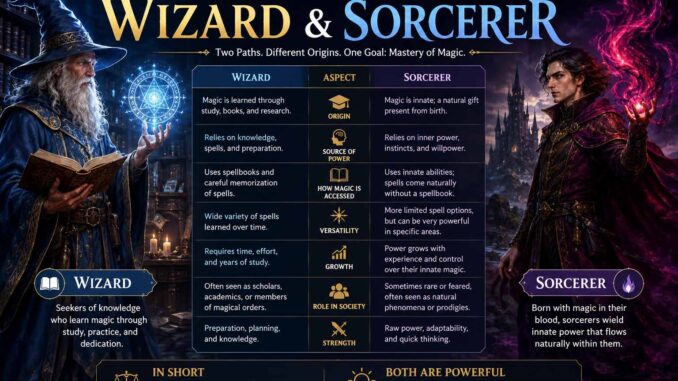
The difference between wizard and sorcerer usually comes down to where their magic comes from and how they use it. A wizard typically learns magic through study, spellbooks, research, and practice, while a sorcerer usually possesses magical power naturally. In games such as Dungeons & Dragons, that distinction also affects spellcasting mechanics, character builds, stats, and playstyle.
However, fantasy games don’t always follow the same rules. One RPG may treat “wizard” as a formal class, while another uses wizard, mage, and sorcerer almost interchangeably. Therefore, understanding both the traditional fantasy meanings and the gameplay differences helps you know what each term actually means.
What Is the Difference Between a Wizard and a Sorcerer?
The simplest answer is learned magic versus innate magic.
A wizard studies magic. They might spend years learning spells, decoding magical writing, studying arcane theory, or experimenting with magical objects.
A sorcerer, by contrast, typically has magic within them. Their abilities might come from a magical bloodline, supernatural event, mysterious blessing, or another source of inherent power.
Here’s a quick comparison:
| Feature | Wizard | Sorcerer |
|---|---|---|
| Magic source | Learned through study | Innate or inherited |
| Classic equipment | Spellbook, wand, staff | Arcane focus or natural power |
| Fantasy archetype | Scholar | Natural spellcaster |
| Typical strength | Spell variety | Flexible spell manipulation |
| Typical weakness | Preparation and complexity | Smaller spell selection |
| D&D casting stat | Intelligence | Charisma |
| Beginner feel | More planning | Smaller toolkit to manage |
These aren’t universal rules across every fantasy universe. Still, they represent the distinction you’ll see most often in tabletop RPGs and games inspired by them.
Where Does a Wizard’s Magic Come From?
Wizards usually gain power by learning how magic works.
Rather than relying on natural talent alone, they approach spellcasting almost like an academic discipline. Books, scrolls, teachers, experiments, and years of practice help them expand their magical abilities.
That makes the spellbook one of the most recognizable pieces of wizard equipment.
A wizard might discover a new spell while exploring a dungeon, copy it into a spellbook, and later prepare it for an adventure. As a result, knowledge itself becomes part of the character’s progression.
This archetype also explains why wizards often have high Intelligence in RPG systems. Their strength comes from understanding complicated magical principles and knowing which spell solves a particular problem.
Players comparing several fantasy spellcasters may also find the difference between wizard and warlock useful because warlocks generally receive power through a pact rather than academic study or an innate magical source.
Where Does Sorcerer Magic Come From?
Sorcerers usually don’t need to study magic in the traditional wizard sense. Instead, supernatural power already exists within them.
Depending on the setting, that power might come from:
- Draconic ancestry
- Wild magic
- Celestial influence
- Elemental power
- A magical event
- Another supernatural bloodline or origin
Consequently, sorcerers often feel less like magical researchers and more like characters learning to control something already inside them.
That difference also affects role-playing.
A wizard’s story might focus on discovering forbidden knowledge. Meanwhile, a sorcerer’s story could revolve around understanding their ancestry, controlling unpredictable abilities, or discovering why they possess magic at all.
D&D Difference Between Sorcerer and Wizard
The dnd difference between sorcerer and wizard becomes more concrete because these are separate classes with distinct mechanics.
Exact class features depend on which version of Dungeons & Dragons you’re playing, so players should always check the rules used at their table. Still, the core contrast remains recognizable.
Wizards Focus on Magical Versatility
Wizards are famous for having access to a broad selection of spells.
Their spellbooks can potentially grow as they discover more magic during a campaign. Therefore, a well-prepared wizard can become an incredibly versatile problem solver.
Depending on the available spells, a wizard may contribute through:
- Battlefield control
- Area damage
- Utility magic
- Defensive spells
- Exploration tools
- Rituals
- Crowd control
However, that versatility rewards preparation. Choosing useful spells before an encounter can make a major difference.
Sorcerers Focus on Innate Casting
Sorcerers generally know fewer spells, yet their class identity emphasizes manipulating the magic they already possess.
Metamagic is a defining part of that experience in modern D&D rules. Depending on the option and ruleset, it can alter aspects of spellcasting, such as range, targets, or casting behavior.
Therefore, a sorcerer isn’t simply a wizard with fewer spells. The class approaches magic differently.
Difference Between a Sorcerer and a Wizard in Gameplay
For players, the difference between a sorcerer and a wizard becomes most noticeable when building and leveling a character.
Choose a Wizard If You Like Preparation
Wizard gameplay tends to reward players who enjoy:
- Large spell selections
- Planning before encounters
- Finding creative utility spells
- Learning game mechanics
- Adapting to different situations
Because there can be many options to consider, wizard builds may feel overwhelming at first. On the other hand, experienced players often enjoy having a magical answer for many different situations.
Choose a Sorcerer If You Like Specialization
Sorcerers suit players who prefer a more focused spell list and a strong magical identity.
You may have fewer spells to manage, but each choice matters more. Therefore, building around a clear combat or role-playing concept can work particularly well.
For example, you might create a sorcerer focused on damage, battlefield control, social encounters, or a particular magical theme.
Wizard vs Sorcerer for Beginners
Neither class is automatically better for every beginner.
A wizard offers flexibility, yet managing a spellbook and preparing spells requires extra decisions. Therefore, players who enjoy researching mechanics may find the class satisfying from the start.
A sorcerer has a narrower spell selection, which can reduce decision overload during preparation. However, choosing the wrong spells can feel more restrictive because you don’t have the same broad spellbook.
A simple rule works well:
Choose wizard if you want more options. Choose sorcerer if you want to specialize.
Magic Style and Character Fantasy
Mechanics aren’t the only reason to choose between these archetypes. The character fantasy matters just as much.
A wizard can fit concepts such as:
- Arcane scholar
- Traveling researcher
- Court magician
- Battle mage
- Ancient librarian
- Magical investigator
Meanwhile, a sorcerer works naturally as:
- Dragon-blooded caster
- Wild magic wielder
- Naturally gifted mage
- Elemental spellcaster
- Mysterious supernatural heir
Fantasy ancestry can shape either concept as well. For instance, players interested in traditional fantasy races and character-building ideas may enjoy exploring types of elves, since elven characters frequently appear as magical archetypes across RPG settings.
Which Class Is More Powerful?
There isn’t a universal winner.
Power depends heavily on the game, edition, character level, encounter design, party composition, player knowledge, and available spells.
Wizards often gain an advantage through versatility. Given enough preparation and information, they can select spells suited to specific challenges.
Sorcerers can shine when their specialized abilities match the encounter. Their spell manipulation can create tactical opportunities that a wizard doesn’t approach in exactly the same way.
So, rather than asking which class is stronger overall, ask which one better supports your preferred playstyle.
Common Wizard and Sorcerer Mistakes
New wizard players sometimes prepare too many spells that accomplish nearly the same job. Instead, build a balanced toolkit with offense, defense, control, and utility where the rules allow it.
Another common mistake is ignoring non-combat spells. Creative utility magic can solve problems before combat even starts.
Sorcerer players, meanwhile, should choose spells carefully because their available selection can be more limited. Look for spells that stay useful across several situations rather than relying entirely on highly specific effects.
Likewise, don’t choose Metamagic or similar class options in isolation. Think about how those abilities interact with the spells your character actually uses.
Wizard, Sorcerer, Mage, and Warlock: Are They the Same?
Not necessarily.
Traditionally, a wizard is portrayed as someone who studies and learns magic, while a sorcerer is often depicted as someone whose magical power is innate or naturally acquired.
“Mage” is a broader term in many games and can describe almost any magic user.
“Warlock” frequently refers to a spellcaster who receives supernatural abilities from another powerful being, especially in D&D-style fantasy.
However, individual games can redefine all four terms. Therefore, the lore and rules of a specific setting always take priority over general fantasy conventions.
Frequently Asked Questions
Are sorcerers born with magic?
Often, yes. In many fantasy settings, sorcerers possess innate magic because of ancestry, supernatural influence, or another internal source. However, individual games may explain their powers differently.
Do wizards need spellbooks?
In Dungeons & Dragons and many D&D-inspired settings, spellbooks are central to wizard identity. Other fantasy games may let wizards cast without carrying a physical book.
Is a sorcerer stronger than a wizard?
Not automatically. Wizards generally emphasize versatility, while sorcerers emphasize innate casting and specialized magical techniques. Their relative strength depends on the rules and situation.
Is Harry Potter a wizard or sorcerer?
The Harry Potter universe uses its own terminology, where “wizard” is the standard term for a male magical person. Applying D&D class definitions directly to another fictional universe can therefore create misleading comparisons.
What’s the easiest way to remember the difference?
Think of it this way: a wizard learns magic, while a sorcerer embodies magic. It’s not a rule for every fantasy universe, but it’s an easy way to remember the traditional distinction.
Which One Should You Play?
The difference between wizard and sorcerer matters most when it changes how you want to experience a game. Pick a wizard when you enjoy preparation, broad spell choices, magical research, and adapting your toolkit to different challenges. Meanwhile, pick a sorcerer when you prefer innate power, a focused selection of spells, and abilities that modify how your magic behaves.
Neither choice is inherently better. Instead, the best class is the one whose mechanics and character fantasy make you excited to play the next session.