
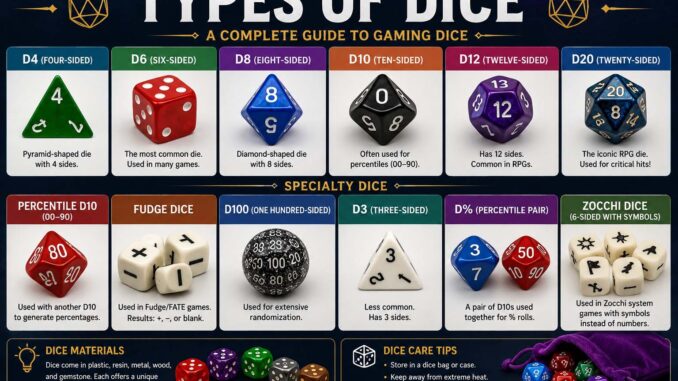
Whether you’re preparing for your first tabletop RPG or expanding your growing dice collection, understanding the types of dice is one of the first skills every player should learn.
Unlike traditional board games that mainly use six-sided dice, role-playing games such as Dungeons & Dragons use several uniquely shaped dice. Moreover, each one has a specific purpose, from determining attack damage to resolving skill checks and random events.
This guide explains all types of dice, how they work, when they’re used, and which ones every player should keep in their gaming bag.
Why Do Tabletop Games Use Different Dice?
Different dice create different probability ranges.
Instead of relying on a single six-sided die, tabletop RPGs use multiple dice to make combat, magic, exploration, and character abilities feel more varied.
In fact, each die changes the odds.
For example:
- A d4 produces smaller numbers.
- A d20 creates a wide range of possible outcomes.
- A d100 offers highly detailed percentage rolls.
As a result, this variety adds excitement and unpredictability to every session. For example, Push your luck explores another way probability can shape play.
Quick Reference: All Types of Dice
| Die | Name | Number Range | Common Uses |
|---|---|---|---|
| d4 | Four-sided die | 1–4 | Small weapon damage, spells |
| d6 | Six-sided die | 1–6 | Standard damage, board games |
| d8 | Eight-sided die | 1–8 | Medium weapons, healing |
| d10 | Ten-sided die | 1–10 | Damage, percentages |
| d% | Percentile die | 00–90 | Combined with d10 for d100 rolls |
| d12 | Twelve-sided die | 1–12 | Heavy weapons |
| d20 | Twenty-sided die | 1–20 | Attack rolls, saving throws, skill checks |
Together, these seven dice make up the standard polyhedral set used in many RPG systems.
Different Types of Dice Explained
Now, let’s look at each die individually.
d4 (Four-Sided Die)
The d4 is shaped like a pyramid.
Players often use it for:
- Daggers
- Small spells
- Healing abilities
- Minor effects
Because of its low number range, it usually represents lighter damage.
Additionally, some players jokingly call it the “foot hazard” because stepping on one can be surprisingly painful.
d6 (Six-Sided Die)
The d6 is the most familiar die.
For example, you’ll find it in games like:
- Monopoly
- Yahtzee
- Risk
- Countless family board games
Similarly, best board games for families commonly feature familiar and accessible gameplay.
In tabletop RPGs, it’s commonly used for:
- Weapon damage
- Creature attacks
- Random tables
- Multiple-dice damage rolls
Moreover, many spells require rolling several d6s at once.
d8 (Eight-Sided Die)
The d8 offers slightly higher damage than the d6.
Typical uses include:
- Longswords
- Warhammers
- Healing spells
- Monster attacks
Therefore, it’s a favorite for versatile weapons that balance consistency and power.
d10 (Ten-Sided Die)
The d10 serves several purposes.
Players often use it for:
- Damage rolls
- Random events
- Loot tables
- Ability effects
Additionally, when paired with a percentile die, it becomes part of a d100 roll.
Percentile Die (d%)
The percentile die looks similar to a d10.
Instead of displaying single digits, it shows:
- 00
- 10
- 20
- 30
When rolled together with a normal d10, you generate numbers from 1 to 100.
For example, games use percentile rolls for:
- Random encounters
- Treasure generation
- Success chances
- Special events
d12 (Twelve-Sided Die)
The d12 appears less often than other dice.
It’s usually reserved for:
- Powerful weapons
- High-damage attacks
- Special monster abilities
Because of its wider range, rolling a d12 often feels especially rewarding.
d20 (Twenty-Sided Die)
Nearly every important action begins with a d20 roll.
Players use it for:
- Attack rolls
- Skill checks
- Saving throws
- Initiative
- Ability checks
For this reason, many players consider the d20 the heart of tabletop role-playing.
Types of DND Dice
When players search for types of DND dice, they’re usually referring to the standard seven-piece polyhedral set.
A complete beginner’s set contains:
- d4
- d6
- d8
- d10
- d%
- d12
- d20
Additionally, some premium sets include extra copies of frequently used dice like d6s or d20s.
As a result, this helps speed up gameplay when multiple rolls are required.
Types of Dice in DND
Understanding the types of dice in DND becomes much easier when you know what each one controls.
| Dice | Main Purpose |
|---|---|
| d20 | Determines success or failure |
| d12 | Heavy damage |
| d10 | Moderate damage and percentages |
| d8 | Standard weapon damage |
| d6 | Common damage and spells |
| d4 | Small damage and healing |
Although every die has a role, the d20 receives the most attention during gameplay.
Why the d20 Is So Important
Most major actions begin with a d20.
Whenever you attempt to:
- Hit an enemy
- Climb a wall
- Pick a lock
- Persuade an NPC
- Detect traps
You’ll usually roll a d20.
For example, a natural 20 often represents an exceptional success.
On the other hand, a natural 1 usually means something goes very wrong.
As a result, these dramatic moments create many of the memorable stories tabletop games are known for.
Choosing Your First Dice Set
New players don’t need an expensive collection.
Generally, a single standard set is enough for most campaigns.
Look for:
- Easy-to-read numbers
- Balanced weight
- Durable material
- Good color contrast
In fact, many affordable acrylic sets perform just as well as premium options.
Acrylic vs Resin vs Metal Dice
The material affects both appearance and feel.
Acrylic
Pros:
- Affordable
- Lightweight
- Large color selection
Cons:
- Less premium feel
Resin
Pros:
- Beautiful designs
- Unique inclusions
- Smooth finish
Cons:
- Higher cost
Metal
Pros:
- Heavy
- Durable
- Premium appearance
Cons:
- More expensive
- Can damage wooden tables
In addition, many experienced players own multiple sets for different characters or campaigns. Similarly, types of elves can inspire themed character dice.
Do Expensive Dice Roll Better?
Not necessarily.
In fact, a well-made budget die can roll just as fairly as an expensive collector’s set.
Higher prices usually reflect:
- Material quality
- Handmade craftsmanship
- Limited editions
- Artistic designs
Ultimately, game performance depends far more on random probability than price.
Advanced Dice Tips
Experienced players often carry more than one set.
Reasons include:
- Faster combat
- Easier spell damage rolls
- Organized color coding
- Backup dice
For example:
- Blue dice for spellcasters
- Red dice for fighters
- Green dice for rangers
As a result, color coding speeds up gameplay during busy encounters.
How to Care for Your Dice
Quality dice can last for many years.
Good habits include:
- Store them in a dice bag.
- Avoid dropping metal dice onto hard floors.
- Keep them away from extreme heat.
- Clean them occasionally with a soft cloth.
- Use a dice tray to protect both the dice and your table.
Overall, simple care helps preserve both appearance and readability.
Common Beginner Mistakes
Learning the dice system takes a little practice.
Therefore, here are some common mistakes to avoid.
Rolling the Wrong Die
Many new players confuse:
- d10
- d12
- d20
For this reason, double-check the number of sides before rolling.
Ignoring the Percentile Die
The d% can seem confusing at first.
Remember:
- One die represents tens.
- The other represents ones.
Together, they create a percentage result.
Buying Too Many Dice Too Early
Generally, one complete set is enough for new players.
You can always expand your collection later.
Fun Dice Accessories
Many tabletop gamers enjoy customizing their setup.
Popular accessories include:
- Dice trays
- Dice towers
- Dice bags
- Storage cases
- Display shelves
Although these aren’t required, they make game nights more organized.
Frequently Asked Questions
How many types of dice are in a standard RPG set?
Most standard sets contain seven dice: d4, d6, d8, d10, d%, d12, and d20.
Which die is used the most?
The d20 is rolled more often than any other die because it determines attacks, skill checks, and saving throws.
Why are there two d10s?
One is a standard d10. Meanwhile, the other is a percentile die used to create numbers from 1 to 100.
Do all tabletop games use the same dice?
No. For example, some games rely only on d6s, while others use custom dice or different combinations of polyhedral dice.
Should beginners buy multiple dice sets?
Not immediately. Generally, one complete set is enough for most players starting their first tabletop RPG.
Ready for Your Next Adventure?
Learning the types of dice is one of the easiest ways to feel more confident at the gaming table. From understanding the different types of dice used in tabletop RPGs to recognizing the types of DND dice and types of dice in DND, each die serves a specific purpose that adds depth and excitement to every adventure.
Start with a standard seven-piece set, get comfortable with what each die does, and you’ll be ready for everything from epic battles to critical skill checks. As you gain experience, you can expand your collection with specialty materials, extra dice, or themed sets that match your favorite characters and campaigns.