
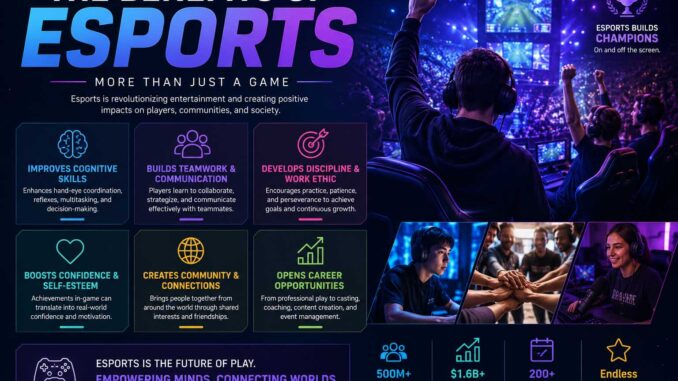
The benefits of esports extend far beyond winning tournaments or climbing competitive rankings. While many people see esports as entertainment, organized competitive gaming also develops communication, strategic thinking, teamwork, and discipline. Whether you’re aiming to compete professionally or simply improve your skills with friends, esports offers experiences that traditional gaming doesn’t always provide.
From school esports clubs to international championships, competitive gaming continues to grow worldwide. Players now have more opportunities than ever to sharpen their skills, connect with teammates, and even explore career paths within the gaming industry.
What Are the Benefits of Esports?
Esports combines competitive gameplay with teamwork, preparation, and continuous improvement. Unlike casual gaming sessions, organized matches require players to practice consistently, communicate effectively, and adapt to changing situations.
Some of the biggest advantages include:
- Stronger teamwork
- Better communication
- Faster decision-making
- Strategic thinking
- Leadership development
- Goal setting
- Competitive discipline
- Community involvement
These benefits apply across many popular esports titles, including multiplayer online battle arenas (MOBAs), first-person shooters, fighting games, sports simulations, and real-time strategy games.
Benefits of Esports for Individual Players
Competitive gaming encourages players to improve through practice rather than luck.
Better Decision-Making
Esports matches constantly present new situations.
Players often need to:
- Analyze opponents
- Predict enemy movement
- Manage limited resources
- React under pressure
Making hundreds of small decisions during a match gradually improves game awareness and strategic thinking.
Improved Focus
Many competitive matches last between 20 minutes and an hour or longer.
Maintaining concentration throughout an entire game helps players develop sustained attention while minimizing unnecessary mistakes.
Many players also enjoy activities that improve concentration outside competitive gaming. For example, the benefits of puzzles can complement esports training by encouraging logical thinking and pattern recognition.
Learning From Mistakes
One of the healthiest aspects of esports is reviewing losses.
Instead of blaming teammates, experienced players often ask:
- What could I have done differently?
- Did I rotate too late?
- Was my positioning correct?
- Did I communicate clearly?
This mindset encourages steady improvement over time.
Benefits of Esports in Schools
The growing popularity of school esports programs has led educators to recognize several educational advantages.
The benefits of esports in schools often go beyond gameplay itself.
Students participating in organized teams frequently practice:
- Time management
- Communication
- Responsibility
- Leadership
- Collaboration
School leagues also provide structured competition similar to traditional sports while appealing to students with different interests.
Benefits of Esports to Students
The benefits of esports to students extend into everyday learning.
Competitive gaming encourages students to:
- Set long-term goals
- Handle wins and losses constructively
- Develop teamwork skills
- Build confidence through practice
- Learn respectful sportsmanship
Many schools also pair esports participation with academic expectations, encouraging students to maintain satisfactory grades while representing their teams.
Students looking for additional recreational activities during breaks may also enjoy exploring fun games to play at school, especially those that encourage cooperation and friendly competition.
Teamwork Is One of the Biggest Benefits of Esports
Success in team-based games rarely depends on individual talent alone.
Communication plays a major role in games such as:
- League of Legends
- VALORANT
- Counter-Strike
- Rocket League
- Overwatch
- Rainbow Six Siege
Strong teams develop habits like:
- Clear callouts
- Positive communication
- Defined player roles
- Trust
- Adaptability
These habits often become more valuable than raw mechanical skill.
Communication Under Pressure
Esports teaches players to exchange information quickly.
Examples include:
- Enemy locations
- Objective timers
- Resource management
- Team positioning
- Tactical adjustments
Clear communication often determines whether a close match ends in victory or defeat.
Strategic Thinking and Game Sense
Mechanical skill attracts attention, but strategy usually separates good players from great ones.
Competitive gaming develops:
- Pattern recognition
- Planning ahead
- Resource management
- Adaptation
- Risk assessment
Games with deep strategic layers reward players who study opponents and learn from previous matches.
Similarly, studying chess strategies for beginners introduces many of the same concepts, including positioning, planning several moves ahead, and recognizing tactical opportunities.
Leadership Skills Through Competitive Gaming
Not every player becomes the team’s captain, but leadership opportunities appear regularly.
Players may lead by:
- Organizing practice sessions
- Reviewing match recordings
- Helping newer teammates
- Coordinating strategies
- Maintaining positive morale
These experiences can transfer into school projects, workplace collaboration, and community activities.
Healthy Competition Encourages Growth
Competition naturally motivates improvement.
Instead of focusing only on winning, successful players usually measure progress through:
- Better teamwork
- Improved communication
- Higher consistency
- Faster decision-making
- Stronger positioning
Small improvements accumulate over weeks and months of practice.
Beginner Tips for Getting Started in Esports
Starting competitive gaming doesn’t require professional equipment or years of experience.
Choose One Primary Game
Focus on a single title before trying multiple competitive games.
Learning one game deeply usually produces faster improvement than constantly switching between genres.
Learn the Fundamentals First
Before mastering advanced techniques, understand:
- Core mechanics
- Maps
- Objectives
- Character abilities
- Team roles
Strong fundamentals provide a solid foundation for future improvement.
Practice With Purpose
Playing hundreds of matches without reviewing mistakes often slows progress.
Instead, choose one skill to improve during each session.
Examples include:
- Crosshair placement
- Resource management
- Communication
- Positioning
- Objective timing
Hardware Can Influence Competitive Performance
Player skill always matters most, but reliable hardware creates a smoother competitive experience.
Useful upgrades include:
| Component | Why It Matters |
|---|---|
| Gaming monitor | Higher refresh rates improve visual smoothness |
| Gaming mouse | More precise control |
| Mechanical keyboard | Faster and more consistent inputs |
| Headset | Better communication and directional audio |
| Stable internet | Reduces lag and packet loss |
Players building or upgrading a competitive setup may also benefit from learning how to choose the best motherboard for gaming, especially when assembling a custom PC.
Common Challenges New Esports Players Face
Every competitor encounters obstacles.
Some common issues include:
Ranked Anxiety
Many players become nervous before competitive matches.
A simple solution is to focus on personal improvement rather than short-term rankings.
Poor Communication
Talking too much can be just as harmful as saying too little.
Effective communication should be:
- Brief
- Accurate
- Relevant
- Respectful
Burnout
Practicing for long hours without breaks often reduces enjoyment.
Balancing gaming with exercise, sleep, school, work, and other hobbies helps maintain long-term motivation.
A Quick Comparison: Casual Gaming vs. Esports
| Feature | Casual Gaming | Esports |
|---|---|---|
| Primary Goal | Entertainment | Competition and improvement |
| Team Coordination | Optional | Often essential |
| Practice | Occasional | Structured and consistent |
| Strategy | Varies | High priority |
| Performance Review | Rare | Common |
| Organized Competition | Limited | Frequent |
Neither style is better than the other. Many players enjoy both depending on their mood and available time.
List of Esports Benefits at a Glance
Here’s a quick list of esports benefits that players often experience:
- Improved teamwork
- Better communication
- Stronger strategic thinking
- Enhanced problem-solving
- Leadership development
- Goal-oriented practice
- Competitive resilience
- Greater confidence
- Social connections
- Community involvement
- Career opportunities within gaming
- Increased discipline through regular training
Individual experiences vary, but these skills commonly develop through consistent participation in organized competitive play.
Career Opportunities Beyond Playing
Professional players represent only a small part of the esports industry.
Other career paths include:
- Coaches
- Analysts
- Broadcasters
- Tournament organizers
- Content creators
- Video editors
- Graphic designers
- Marketing specialists
- Community managers
- Event production staff
As esports continues to expand globally, supporting roles remain an important part of the ecosystem.
Frequently Asked Questions
What are the benefits of esports?
The benefits of esports include teamwork, communication, strategic thinking, leadership, problem-solving, discipline, and opportunities to participate in organized competitive communities.
What are the benefits of esports in school?
The benefits of esports in school include collaboration, leadership, goal setting, social engagement, and structured extracurricular activities that encourage teamwork and responsibility.
Can esports improve communication skills?
Yes. Team-based esports require players to share information quickly, coordinate strategies, and support teammates throughout a match.
Do you need expensive equipment to start esports?
No. Many competitive games run well on entry-level gaming hardware. As players become more serious, upgrading components can improve performance and overall experience.
Is esports only for professional players?
Not at all. Most participants compete casually through schools, local clubs, online leagues, or community tournaments while enjoying the social and competitive aspects of organized gaming.
Taking the Next Step in Competitive Gaming
The greatest benefits of esports come from approaching competition with the right mindset. Winning is rewarding, but long-term improvement comes from learning, practicing, communicating well, and supporting your teammates. Whether you’re joining a school club, climbing online rankings, or competing in local tournaments, every match provides an opportunity to build valuable gaming and life skills.
Focus on steady progress instead of immediate results, review your performance regularly, and enjoy the process of becoming a better player. Competitive gaming is at its best when improvement, teamwork, and sportsmanship are just as rewarding as victory.