
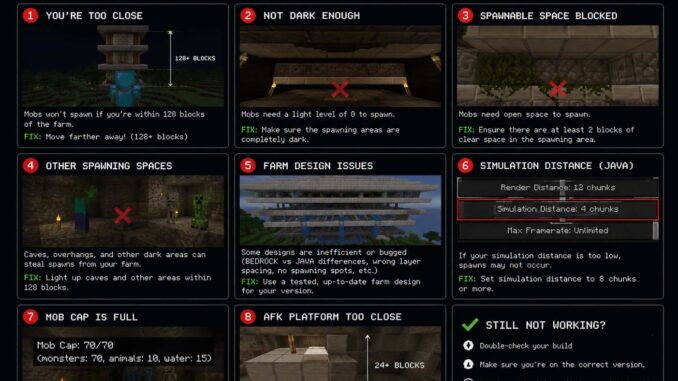
You’ve finally finished building a mob farm, but nothing seems to be spawning. If you’ve been asking why is my mob farm not working, you’re not alone.
The good news is that most problems are easy to fix once you know what to check. This guide walks through the most common causes, explains why they happen, and shows you how to get your farm producing mobs efficiently again.
Why Is My Mob Farm Not Working? Start With These Checks
Before rebuilding your farm, run through this quick checklist.
| Check | Why It Matters |
|---|---|
| Light level | Hostile mobs require darkness to spawn. |
| Player distance | Standing too close or too far prevents spawning. |
| Difficulty setting | Peaceful mode disables hostile mob spawns. |
| Nearby caves | Hidden caves steal spawn attempts. |
| Spawnable blocks | Slabs, glass, leaves, and carpets prevent spawning. |
| Mob cap | Existing mobs may fill the spawn limit. |
Most farms begin working again after fixing one or two of these issues.
Make Sure the Spawn Platform Is Dark Enough
Hostile mobs only spawn under specific light conditions.
If your spawning platforms receive light from:
- Torches
- Lanterns
- Glowstone
- Sea Lanterns
- Sunlight
- Lava
then spawn rates will drop dramatically or stop completely.
For modern Minecraft versions, keep spawning platforms completely dark unless your farm is designed for specific mobs with different spawning rules.
Check Your Distance From the Farm
Player position is one of the most overlooked problems.
Hostile mobs generally spawn:
- More than 24 blocks away from the player
- Within the game’s spawning range
- Before reaching the despawn distance
If you AFK too close, mobs won’t spawn.
If you’re too far away, they despawn before reaching the collection system.
Many efficient farms include an AFK platform positioned at the correct height above the farm.
Nearby Caves Can Ruin Spawn Rates
This is one of the biggest reasons players search why is my minecraft mob farm not working.
Minecraft attempts to spawn mobs throughout loaded chunks.
If dozens of caves below your farm remain dark, mobs spawn there instead of inside your structure.
Ways to fix this include:
- Lighting every nearby cave
- Filling cave entrances
- Building the farm high above the ocean
- Building above deep water where fewer spawnable blocks exist
If you’re collecting resources before building your farm, knowing the best level for diamonds 1.20 helps you gear up faster before tackling large underground lighting projects.
Confirm the Game Isn’t Set to Peaceful
This sounds obvious, but it happens surprisingly often.
On Peaceful difficulty:
- Zombies disappear
- Skeletons disappear
- Creepers disappear
- Spiders disappear
Switch the world to Easy, Normal, or Hard before testing your farm.
Are You Playing Bedrock Edition?
Many players specifically search why is my mob farm not working bedrock because Bedrock Edition handles spawning differently than Java Edition.
Some important differences include:
- Different simulation distance behavior
- Separate mob spawning mechanics
- Slightly different mob caps
- Different despawn rules
That means a Java tutorial doesn’t always work perfectly in Bedrock.
Whenever possible, follow tutorials built specifically for your edition of Minecraft.
Check Every Spawning Block
Hostile mobs only spawn on suitable blocks.
These blocks usually work:
- Stone
- Cobblestone
- Dirt
- Deepslate
- Concrete
These blocks prevent spawning:
- Glass
- Bottom slabs
- Leaves
- Carpet
- Buttons
- Rails
One misplaced slab can stop an entire platform from working.
Walk through every spawning floor carefully.
Verify Water Streams Are Working
Many farms rely on water to move mobs toward a drop shaft.
Check for:
- Water flowing the correct direction
- Missing source blocks
- Waterlogged blocks
- Signs placed correctly
- No gaps where mobs become stuck
Even if mobs spawn successfully, poor water flow can make the farm appear broken.
Is the Mob Cap Already Full?
Minecraft limits how many hostile mobs can exist at once.
If nearby mobs already occupy the cap, your farm produces very little.
Common causes include:
- Underground caves
- Surface mobs at night
- Zombie villages
- Animal farms mixed with hostile spawning areas
Sleeping through the night or lighting the surrounding area often improves performance.
Spawn-Proof the Surrounding Area
Professional builders spend almost as much time outside the farm as inside it.
Spawn-proof nearby terrain using:
- Torches
- Slabs
- Carpets
- Leaves
- Water
This forces more spawn attempts into your farm.
If your base includes mining tunnels, checking the best y level for iron can help you gather building materials while lighting underground areas at the same time.
Check Your Simulation Distance
Recent Minecraft updates allow players to adjust simulation distance.
If it’s set too low:
- Mobs may not move correctly.
- Water systems stop processing.
- Farms become inconsistent.
A moderate simulation distance usually offers the best balance between performance and reliable mob farming.
Is Your Farm Built Too Low?
Many older tutorials recommend building farms close to the ground.
Today, many players build high in the sky because:
- Fewer nearby spawnable blocks
- Better efficiency
- Less cave interference
- Easier AFK positioning
Ocean-based farms are especially popular for this reason.
Common Farm Design Mistakes
Sometimes the design itself causes problems.
Watch for these issues:
Platforms Too Small
Tiny spawning platforms naturally produce fewer mobs.
Increasing platform area often improves output.
Incorrect Ceiling Height
Most hostile mobs require enough vertical space.
If ceilings are too low, certain mobs won’t spawn.
Mobs Can’t Reach the Kill Chamber
Poor water flow, trapdoor placement, or pathfinding issues can leave mobs wandering instead of falling.
Watch the farm in Spectator Mode (Java) or from a safe viewing point to identify bottlenecks.
Java vs Bedrock Mob Farm Differences
| Feature | Java Edition | Bedrock Edition |
| Mob spawning | More predictable | Different spawning rules |
| Tutorials | Widely available | Requires Bedrock-specific designs |
| AFK positioning | Very important | Also important, but mechanics vary |
| Spawn rates | Often higher | Depends heavily on simulation settings |
This explains why players often ask minecraft why is my mob farm not working after copying builds from videos made for another edition.
Advanced Tips for Better Spawn Rates
Once your farm works consistently, you can improve efficiency even more.
Try these upgrades:
- Build multiple spawning layers.
- Increase platform size.
- Use efficient water timing.
- Remove unnecessary light leaks.
- AFK at the ideal height.
- Spawn-proof every nearby chunk.
Small improvements often increase results far more than rebuilding from scratch.
Keep Your Weapons Ready
Mob farms quickly generate experience and valuable drops, but you’ll also spend plenty of time fighting mobs while testing new designs.
If you’re planning to use the powerful Breeze weapon introduced in newer Minecraft updates, our guide to the best enchantments for mace explains how to maximize its damage for clearing hostile mobs.
Common Questions
Why aren’t any mobs spawning?
The most common causes are:
- Too much light
- Standing too close
- Peaceful difficulty
- Nearby caves
- Incorrect farm design
Check those first before making major changes.
Why is my mob farm so slow?
Slow farms usually suffer from competing spawn locations or poor player positioning rather than broken mechanics.
Lighting nearby caves often provides the biggest improvement.
Does building higher improve efficiency?
Yes.
Sky farms reduce competing spawn locations and usually perform much better than farms built close to the ground.
Why does my farm work sometimes but not always?
Mob spawning depends on loaded chunks, player position, simulation distance, and nearby mobs.
If any of those conditions change, performance changes too.
Do Minecraft updates break mob farms?
Occasionally.
Major updates sometimes adjust spawning mechanics, AI behavior, or mob caps. If a farm suddenly stops working after an update, check recent patch notes or compare your design with newer community builds.
A Working Mob Farm Comes Down to the Details
Most players searching why is my mob farm not working in Minecraft discover that the issue isn’t the farm itself. Instead, it’s usually a small detail like light levels, player distance, nearby caves, or spawn-proofing.
Rather than rebuilding everything, inspect your setup step by step. Test one change at a time, watch how the farm behaves, and adjust only what’s necessary. Once the spawning conditions are correct, even a simple design can produce a steady stream of experience, loot, and resources for the rest of your survival world.